Our work here is done…

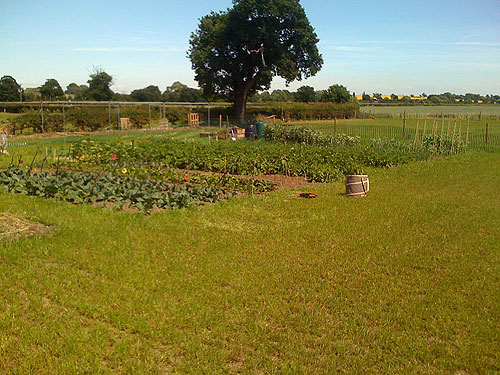
…for now! For the first time I wombled down to the patch and just sat there, feeling quite content that the hard work by all was finally paying off and we’d started to eat the produce. Sometimes it’s just perfect to not pick up the hoe or spade,a nd to just appreciate the result of all that slog.

Planting Strawberries

Today was the day to set the newly arrived strawberry plants. First job was to make the wooden frame to border the plants, Smiler helped me with the sawing, and Jay helped set the straw around the plants to help check weed growth, put of slugs and snails, and help keep moisture in. Next year we’ll hopefully take the runners and have more from them.

As usual, the weeds are in full growth, as is the grass. Ian from next door is helping keep the grass down by topping it for us once the sheep have eaten it down, whilst Suz and Jay hoe – hard life!

Quick Update – Weeds & Vermin

I realise I haven’t posted here in a few weeks – life is pretty busy at the moment, and the patch is definitely a big part of that! Suffice to say that I have pretty much sown I am going to sow – the last sucessional broadbeans, snap peas, peas, dwarf french beans and carrots have gone in. I have also sown butternut squash (F1 Cobnut) and more corgettes.

The labour of love this past 3 weeks has most definitely been ‘dealing with things not wanted in the patch’.

The first being WEEDS – so many they deserve capitals. If I had twinkly lights I’d drape those over the word as well. The very first sowings we made way back were competing with the weed seeds already in the ground, and of coursem we couldn’t weed around our seeds until they showed themselves, so May was a good time to lay into the neat weed carpet around our pickling onions, spring onions, carrots and main crop potatoes. I kid you not we have filled at least two compost daleks with weeds, with the later stuff alreday in flower going straight in the brown bin – I’m not composting potential seeds to put back in the ground! My least favourite weed, as you may already know, is twitch, but we have none of that in the beds we’re using. We do however have heaps of chickweed – fun stuff to pull out if you get it right, groundsel, shepherd’s purse and my favourite – wild pansies. They are gorgeous little things but I console myself that for each one I pull out there are hundres more to replace it in the grazed parts of the field. There are others I don’t recognise yet – anything I don’t know gets brown binned in case!

The chickweed in the grazed area is being dealt with by sheep – both local farmers reckon it’s the best way to deal with it without resorting to chemicals, so I bow to their combined 150 years of wisdom. The chickweed around the veggie patch is being mown short regularly – I’ve heard regular short mowing is best for it, but we’ll see – I’m not so sure. Many a time I’ve gone out to mow, and end up crawling around the place, tearing chickweed out as the red mist decends.

The next pest are the flying types…wood pidgeons and a resident pheasant accompanied by his 3-strong hareem has managed to devoid farmer John and Gary next door of their beetroot. Luckliy we’re at the end, so our beetroot has been nibbled, in places to within an inch of its life, but it has survive d and now lives under a cosy net tunnel. Sweet, beetrooty, dreams. They have also had a bit of a bash at the peas and cabbages, but my old cover CD collection is now happily flapping in the breeze, tied to old willow sticks I have left from last year. It seems to be working.

Slugs are making a pathetic attempt to nibble the snap peas, but they’re large enough now to shrug it off I think, and black fly are starting in the broad beans. I need to figure out what to do here – last year I used ecover washing up liquid mixed with water on some veg with green and white fly, but it seemed to burn the plants more than rid them of crawly nasties.

The last unwanteds are the walking lawn mowers I’ve borrowed from a local farmer – the escapologist lambs who’ve decided that not only is the grass greener in the vegetable quarter, but so is practically everything else, and have managed to nibble practically everything at least once to try it out. Let it not be said they’re not adventurous beasties.

I’ll pop some pictures of how it’s all looking these days – much different and half-decent if I do say so myself!

Successional Sowing & Brassicas

Today I managed to get the final batch of mangetout sown. The first batch is suffering a bit from hungry slugs so I’ll start to save some plastic bottle tops to make mini-cloches to go over them at night. Once we have some tree growth – in a few years – we’ll be able to encourage the birds to loiter around the patch. It worked wonders in the first veggie patch – after a year of encouraging the birds the slugs were virtually nil!

I also picked up some brassica plugs from the local market gardener who produces them by the hundreds and thousands for their own use. £5 bought me 50 plants:

  • 20 pointy cabbages
  • 20 round cabbages
  • 10 brussel sprouts
  • a couple of hanging basket tomatoes

In some ways I feel like a charlatan for not having grown them from seed, but then the seed would have cost more for the amount we want to plant!

Weeds and Potting-on

An unpleasant job today – I tackled the weed issue on the old acre field headland, or ‘adlan’ as farmer John pronounces it. With years of non-ploughing it is full of many weeds, the majority being cleaver which is working its way up the hawthorn mix hedge, and twitch (couch grass) which is spreading into the field by about 20 foot. As the allotment quarter has been affected by the twitch, making the planting of any long-term plants such as fruit bushes a bit risky, we’ve decided to use Roundup weedkiller on this particular patch of headland to remove everything. I don’t like the use of chemicals but all the local farmers suggest this is the only way unless I can plough the area constantly over the space of a year. I’ve left the headland as is where the orchards will be, but under the existing hedgerow that needs maintenance I’m clearing the weeds.

Once the weeds are cleared, under the existing hedgerow I’ll plant new hawthorn whips to fill the gaps. Over all the cleared headland area I’ll sow a grass/meadow flower mix to replace the food supply for the birds that I’ll have removed to an extent by killing the weeds off. Hopefully this mix will supress any particularly viruelnt weed, such as the cleavers and twitch, from becoming too dominant again.

The next job was to pot up the tomatoes and chillies. Due to the size of our greenhouse I’m putting off sowing the butternut squash, pumpkins and sweetcorn until I can sow directly into the soil where they’ll grow. I also sowed in a greenhouse tray a packet of Loretta celery seed.

General Update

Today was quite a busy one – the fencing is finally finished and after more advice over the weeds in the field, we’ve decided to ask a local sheep farmer to pop some sheep into the field to eat it down and tread over the grass to firm the roots up. Today the sheep weren’t too accomodating in that they ran in the opposite direction when  we tried to lure them with a bucket of grain. The fact that the bucket was empty might have had something to do with it.

On the sowing side of things, the first row of Dwarf French Beans went in – Ferrari. The strawberries also arrived this morning so a quick 30ft long trench had to be dug over and old horse manure mixed in. Four varieties were planted in total:

  • Korona
  • Honeoye
  • Hapil
  • Florence

Topping & Potting

Today was all about a bit of lovin’.

The poor chooks, whilst happy with their new palatial grassy space, were having to combat excessively tall grass (about 5″), so raising the mower to its highest cut setting I mowed their paddock to a better 3″ height – they do love the lower grass to graze on, and longer grass is more likely to cause an impacted crop.

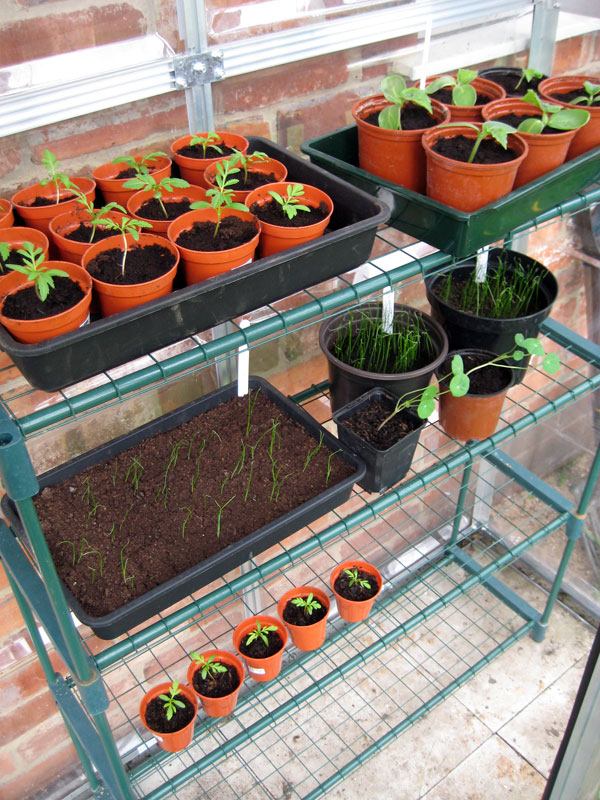
The second bit of lovin’ was to pot on the various seedlings covering the windowsills. The marigolds went into 3″ pots, the nasturtiums went into 4″ pots and the cucumbers went into 5″ pots. The tomatoes really do look ready to go into bigger pots but I’m hoping I can blag it for another fortnight as they’ll be in growbags soon enough once mid May has come. I’ll probably give in and repot them though – I don’t fancy them getting leggy.

This photo shows our mini greenhouse with a selection of each type – the rest are in the house and back cluttering up the windowsills as they should do. It’s a little experiment to see which survive the happiest 🙂

On another plus-side – the corgettes I sowed back whenever it was, have all germinated, so I ended up pulling out the second from each station. I’ve transplanted those into new positions outside of a cloche – again, just to see if it works! The forecast is good for the next week, so it may prove a good bet we get no more frost this year. We’ll see 🙂

Fruit Cage

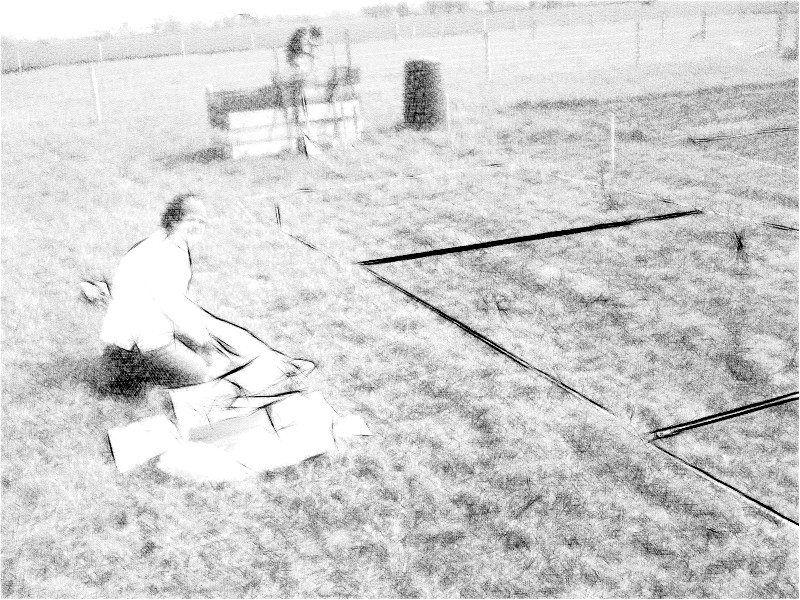
As a 40th birthday present, my parents and Suz clubbed togther to buy a fruit cage for the patch – a fantastic present that I am so grateful for! Whilst the soft fruit we’ve planted there probably won’t fruit this year we thought it made sense to get the frame built – one less thing in the garage and it was a fun thing to do anyway! Here Suz struggles with the instructions, whilst I capture the moment and Clive, the fencing guru, does his magic in the background!

You can see here the 9m x 3m cage extends a few feet beyond the end of the raspberry row – this has nothing at all to do with my method for converting from meters to feet (multiply by 3) – honest. Lucky I don’t work for somewhere important where it would really matter eh? Like NASA for instance…

Asparagus & Potatoes

Possibly a bit late – we’ll wait and see – but seed potatoes arrived from Dobies to fill the space we’ve left in the allotment patch. I put in another 4 rows of:

I think it’s safe to assume there will be garden-gate sales of potatoes this year!

The last, but most definitely not least, thing to go in was two varieties of asparagus:

  • Stewart Purple
  • Pacific 2000

Having never seen an asparagus root, it was quite a fascinating process planting them and they look pretty weird as well – a cross between an octopus, a dreadlock wig and and alien! If looked after well this bed will last around 20 years, so whilst they’ve been slotted in to the proposed brassica patch they’ll sit tight, along with the Jerusalem Artichokes next door, for several years. Below is a series of photos showing the planting process – a trench 12″ wide and 8″ deep is dug, a 4″ high mound if made in the middle over which the asparagus crowns are draped, then soil backfilled to around 2″ over the crowns and patted down gently. As the spears start to show, the remaining soil is earthed up over them.

Fruit Patch

The twitch issue in the original fruit patch meant a quick scrabble to find a place to put the fruit netting cage, and patches for the gooseberries, rhubarb and strawberries that had already been ordered from Pomona Fruits and had arrived that morning!

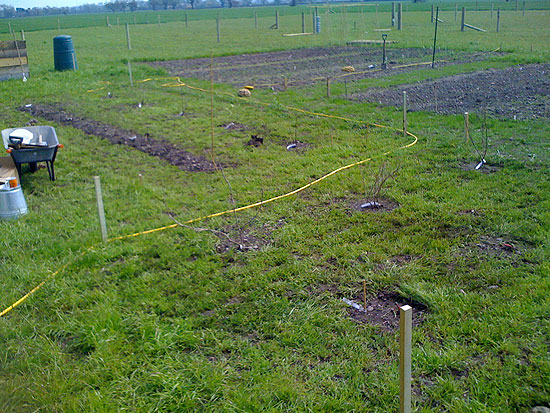
The space which was provisionally kept free for a storage shed was perfect as it faced south, so today Suz and I set to, digging holes and trenches, turning the turf upside down after filling the base with well rotted horse manure, and planting the fruit.

In went:

  • Glen Ample Raspberries
  • Tulameen Raspberries
  • Malling Jewel Raspberries
  • Ben Connan Blackcurrants
  • Big Ben Blackcurrants
  • Jonkheer van Tets Redcurrants
  • Rovada Redcurrants
  • White Versailles Whitecurrants
  • Timperly Early Rhubarb
  • Hinnonmaki Red Gooseberries
  • Hinnonmaki Yellow Gooseberries
  • Invicta Gooseberries

The raspberries and currant bushes will be kept under fruit netting. The strawberries, which are yet to arrive, will have their own smaller netting, and the rhubarb and gooseberries will be left to fend for themselves in the open…poor things.