Lost Grace :(

I’m sad to say that we lost Grace yesterday evening. She had been off antibiotics for 2 days, and had passed one small (about 5mm diameter) poop. She was drinking quite a bit, but would only nibble at food, and was reluctant to tuck into anything. Interestingly she would only tuck into the critical care formula, the liquid food we syringed into her mouth, and she was eating an awful lot of dirt.

We tried everything food-wise – cabbage, beetroot leaves, apples, orange, dandelion leaves, nasturtiums, rocket, grass, clover, poultry spice pellets, layers pellets – you name it, we tried it, and all were met with the same ‘ooh, I’ll have a nibble’ but then rejected.

We have left her with the Minster’s Vets in Sutton Bonington who are going to carry out a gross post mortem, just in case it’s something that can affect a flock. I should know later today, fingers crossed it’s nothing contagious.

As it is, I suspect we’ll be keeping our little female gosling, she may even be Grace’s.

Another Grace Update

Yet another update on Grace’s situation.

She has continued to walk around, though wobbly with it. There have still been no signs of much eating – the odd nibble here and there, but we’re still syringing Critical Care formula down her every morning and evening.

We also noticed that her poops were starting to turn green – we thought that was a good thing as perhaps she’d started to take in grass or clover, but we were wrong. Yesterday she also seemed a bit more listless than before, and a bit more wobbly. We called the vets as we had run out of our 7-day Baytril treatment and the critical care formula. Popping to them they gave us another three days worth of Baytril, saying they liked to continue with an antibiotic until the problem had cleared up. We also bought some probiotic powder to help replenish the gut flora. She had her first dose of this yesterday. We also gave her the second dose of Panacur by syringe.

Today we followed the by-now normal morning routine – except the Metronidazole had run out. So 0.9ml of Baytril syringed into her mouth, followed by a syringe of liquid consisting of 3 heaped teaspoons of critical care formula, a very small amount (a pinch) of probiotic powder and water to form a syringable paste. We then mixed her soup – 400ml water, 3 heaped dessert spoons of Oxbow Critical Care for Herbivores, a handful of wheat grain, two teaspoons of probiotic and 3 heaped teaspoons of critical care formula.

Then I had a little panic. It had been almost two weeks of illness, 11 days of treatment, and she still wasn’t eating and drinking as normal, but she was walking around. It didn’t seem right. A thought ocurred – maybe she had Hardware Disease? All the symptoms seemed to be right for it. So I called our vets again, mentioned it, and they suggested I needed a poultry specialist. Is there one near us? Sure – head over to:

https://www.minstervets.co.uk/poultry

23 minutes away, but a free advice service!

I spoke to a lovely chap, Mike Clark, whose advice is below (I wish I had recorded the conversation):

Stop all antibiotic treatment. Typically, in an average sized fowl it you should expect to see an improvement after 3 days. Turkeys, the largest they treat, it’s a 5-day window. 10 days means that anything in our Grace that could have caused her harm is long gone. The Metronidazole is great at attacking gut infections, and is very strong. Baytril is a bit of a sledgehammer and attacks pretty much everything. So anything bad will have gone, as will anything good! So feeding her probiotics at the same time as Baytril is inneffective. The green poop we were seeing was actually stomach bile, not passed food, meaning nothing had been eaten. The clearer diahrrea is a better sign. Leave 24 hours after the last does of Baytril before administering probiotics, as then they will be effective. Only one dose of probiotic is enough – they multiply like crazy in the gut. Continue syringing the critical care formula.

The effect of the above will allow the gut to re-establish its flora and to allow her to recover from the heavy doses of antibiotics she’s been on. She should, in theory, feel better from the lack of antibiotics, and should start to eat again properly, with her stomach feeling more normal.

We need to allow about three days to see the difference. If she has made no improvement by Monday then we need to call the vet. If the symptoms still persist it may be that the initial Heat Stress has caused damage to either the liver or kidney. This will mean a blood test to look at her biochemical levels – a vet, if they have their own equipment, can recalibrate it for geese, or they can send the blood samples to an external outfit such as IDEXX who will have a normal goose reading on their records to compare the blood sample with.

So fingers crossed for the next three days – they seem to be the most crucial! He did say that if she has managed to pull through for 10 days then in his mind she stands a good chance of recovery – typically an illness would have taken her before now.

Regarding the wormer – he did say that there were two possibilities with regards worms. She either had a minimal or no level of worms, in which case the medication would have been yet another medication for her to cope with. Or she had a high level of worms and they were yet to be killed off. He preferred Flubenvet to Panacur – I  can’t remember the reasoning, but did agree that Panacur was the easiest to administer to a goose, being a liquid. However, I will attempt to cover some wheat grain in a bit of olive oil so that Flubenvet will stick to it, and give it to the two remaining geese that way. You can usually rely on them eating wheat grain! He said you might notice any larger worms in the faeces, but we have seen nothing so suspect she’s okay in that respect. Our stocking density is very low – three geese on a quarter acre of grass, so worms wasn’t our major suspect, but you can never be too careful I guess.

Grace Update

Grace is still with us. It’s still touch and go, and very intensive. She is actually on two antibiotics, the first was prescribed by the initial city vet that we had to visit as they were the only local vets that could see her at such short notice. The second, Baytril (the standard poultry offering) was prescribed by our normal vet who is quite up on poultry, having a farming section. Baytril was suggested as, according to them, it can help with infections of the brain area whereas the other antibiotic we have can’t. So, every morning Grace has 0.9ml of Baytril, 3.1ml of the other antibiotic, then three heaped teaspoons of a critical care powder (essentially an energy, mineral and vitamin mix), mixed with a little water and syringed in to her mouth. Every night she has another 3.1ml of the unknown antibiotic, another three heaped teaspoons of critical care powder mixed with water, and some fresh greens to try and tempt her. The vet suggested 11 teaspoons of the critical care powder a day if we could, so we’re probably giving her near that with the heaped teaspoons, but it’s a lot of syringing and it must stress her! Suz’s coat (she holds Grace whilst I do the business end) is covered in the sticky stains from it – Grace has learned to take the syringed liquid into her mouth but close her beak so the liquid sits in her mouth. She then keeps her beak shut, pretending to have swallowed it, until she’s quite confident that *you* think she’s swallowed it. Then she’ll defiantly shake her head, showering anyone near with sticky white gloop! Talk about a battle of wits! Now when I syringe it in I prise her beak apart with my middle finger and thumb, holding her head in my hand from the back. I place the syringe in the front of the beak, so she can bite down on that if she likes and I use my two fingers to keep her beak from moving sideways to remove the syringe, and syringe enough in to sit at the back of her tongue. Too rough and it squirts down her throat which is not good, too gentle and it sits on the tip of her tongue and she refuses to swallow it! Once it’s on the back of her tongue I move my two fingers to form a ring around her beak so she can’t shake her head to gloop us, and to also keep her head level so she can’t drop her head to allow the gloop to drop under gravity. This technique works almost flawlessly – maybe I should try and video it, it’s taken six days to master!

Then we also mix more of the critical care powder with some Oxbow Critical Care (a mix of timothy hay and more vitamins and minerals in it) into a small bowl of water which she is encouraged to drink by leaving it under her nose. We also throw some wheat grain into this, and some nasturtium leaves, parsley leaves and dandelion leaves cut into small bits to float on top. The whole concoction is called “Grace’s Soup” by us all – she seems to like dunking her beak into it, and anything she does swallow from that bowl is doing her some good. Also, once we’ve been through a ‘syringing various liquids into the goose’s mouth’ saga, she likes to rinse her mouth out, so we place the soup in front of her so she’s rinsing with something else good for her!

What we have found is that being totally separated from the other two, one of whom is her hubbie, seemed to get her really down. So we’ve placed the small field shelter the other side of the gate from her two friends, so she can see them through the chicken wire stapled to the gate. We then place her under the field shelter, surround her with her various bowls (Grace’s Soup, a big low bowl of fresh clean water, a small bowl of layers pellets with added poultry spice pellets, and a small pile of whatever greens we’ve picked that she might like to pick from), and she can see them and they can see her, but they can’t get too close to her and they can’t steal her food! Importantly, we also place their drinking bucket of water the other side of the gate, and we’ve found that when they take a drink, she’s more likely to take a drink from hers, to join in!

At night we bring her back nearer the house to the ‘goose hospital’, which is a large dog crate, filled with plenty of fresh hay, covered with a waterproof tarp. The whole thing is in the old pig sty which we use as a log store, so it’s nice and cosy and covered.

After a week of this, her poops have gone from water to a runny green, but thicker by the day for the last three days. She can now stand on her own two legs, albeit quite wobbly, and she’s started to eat dirt a few days ago and pull at small tufts of greenery. She’s not eating a lot though, so today we’ve spoken to our normal vets again who have suggested another three days of Baytril, and we’re also going to start her on a probiotic mix to try and replenish her gut flora. After three days on that we’ll reassess.

Her feathers continue to grow from the moult, bless her, and her bite, which was quite pathetic at the start when I used my finger to keep her beak open whilst syringing the various fluids into her mouth, is now most definitely more acute. To the point that I really do try and keep my fingers out of the way!

So, to cut a long story short, she’s heading in the right direction, she’s not out of the woods yet, but it’s better than it was three days ago! But she really is a lovely goose – lovely colouring and very placid – worth fighting for!

Grace Update

We took some advice from Steeple Ducks about using a small stick to prop Grace’s beak open whilst we syringed liquids into her mouth- what a wonderful technique! It only needed to be about 8mm in diameter, near the end of her beak. That way there was enough space behind the stick to squeeze some nutrient mix on to her tongue, then quickly pull the stick out so she could swallow it. Not a quick process but less hassle for us and her to open her beak whilst holding her head in place!

Steeple Ducks also suggested that the Baytril thing is perhaps a concern about increase in resistance to antibiotics. Perhaps if we ingest it even in minute quantities we could develope a resistance to ones prescribed to humans? They may well be right about the Baytril – the first vet we saw about our ill bantam suggested that the medical profession was leaning on them about the over-use of antibiotics. I imagine it’s all related to the general problem with antibiotic resistance and bolting doors that can be bolted.

Today she’s still with us, and no worse than yesterday, which is good. As I said in my previous post, we have managed to get a small amount of nutrient mix into her, and she’s taking water and some mix of her own accord. She’s not eating a lot, but then she seems to be having little and often. She has started to dig into dirt that she finds in the grass – I wonder if she’s after the minerals in the dirt, or the roots of the grass. Either way she seems to have more strength, but tires easily. With our chicken it took about 3 days on antibiotics to see a noticeable difference so as long as she’s bouncing along the bottom but getting no worse over the next two days I won’t panic. If she looks worse before then then we’ll possibly take her back to the vets for more treatment.

Poorly Grace – Sun Stroke?

Here goes. Two days ago we noticed one of our moulting geese, Grace, was a bit listless, wobbly on her feet, and not eating a great deal. She’d also taken to sitting down quite a lot, in the full sun. We have had a heat wave into the high 20s, early 30s for a week or so and, despite having a field shelter, the geese have taken to wandering around in the full glare.

Our other goose, Lucy, had also been listless and lacking energy about 3 weeks ago, and was also going through the moult, but this was before the heatwave, and is now plodding around happily with Barty the gander.

Worried that something was amiss, we decided to part Grace from the flock and bring her near to the house where we could keep an eye on her. There was also more shelter from a large fence, should she decide she needed it. We also gave her her own bucket of water, another lower water bowl in case she was too tired to stand, a bowl of barley corn (there is some doubt over the suitability of barley for geese – this needs more research), layers pellets, and a selection of freshly picked greens. She nibbled at the corn and pellets, but didn’t touch the fresh stuff. She would also take some water occasionally. During the day she got neither better nor worse.

We looked to the ever-helpful Pilgrim posse on mail, and had suggestions that worming her may be a good idea, and possibly treating for heat stress (cooling her down with a damp towel, dipping her beak in the water to encourage her to drink).

This book was suggested for diagnosing ailments:

https://www.amazon.co.uk/Poultry-Waterfowl-Problems-Gold-Cockerel/dp/0947870261/ref=as_li_tf_mfw?&linkCode=wey&tag=debbikings-21

The next day we were greeted with clear and runny poop, so we whisked her off to the vets who prescribed her with the antibiotic Metronidazole and the wormer Panacur.

Whilst being initially offered Baytril, the usual antibiotic cleared for use in poultry, the vet mentioned we wouldn’t be able to eat the eggs once administered. We said we knew this, the usual fortnightly wait before it was safe, but she informed us we would never be able to eat the eggs again! Crikey – that’s a turn up!

We were also advised that 2ml of Panacur per 1kg in weight per bird was to be given once daily for three days, so 5ml for our Grace was the dose!

Alarm bells once again sounded, so I called Chris Ashton of Ashton Waterfowl for some advice. Chris said that vets tend to just multiply quantities based on animals they know, but that 2ml per adult Pilgrim would be plenty. And to combat gizzard worm you only need to dose once, then again in 1-2 weeks time – two doses in total. The staggered dosing is to kill the emerging adult worms the first dose missed, as Panacur is not effective against the eggs of the gizzard worm.

As for the Baytril, it seems to be a misinterpretation of the regulations, but in practice you can eat the eggs 14-18 days after administration. That being said, a recent visit to another vet with a poorly chicken we bought (we didn’t have the heart to leave her with her owners), we were also told that Baytril was no longer an option and that they had to give us something else – amoxicillin – a paediatric banana-flavoured antibiotic. It worked, but I’m sure their reason was something along the lines of ‘clamping down on the over-use of antibiotics’.

So there are the official quantites for Panacur for Pilgrim geese, from Chris. And as for the antibiotics, there seem to be many discussions online around people’s experiences of it – for example:

https://poultrykeeperforum.com/viewtopic.php?f=3&t=5599&start=10

I’m still not sure about Baytril’s current standing, but one vet said they can no longer prescribe it, and the other said we can’t eat the eggs ever again if they did so. All theories welcome.

We’re now on the evening and we have given the first doses of both, much to Grace’s disgust. It’s relatively easy to squirt the stuff into her with one adult hugging her and the other doing the messy business of holding her mouth open and syringing. However, it has crossed my mind that this is a weakened goose and that, if all goes to plan and the liquids do their job, by the time she’s ready for her second dose of Panacur she’ll be a darned sight less amenable to having her beak prised open by a ham-fisted, syringe-toting human slave. I’ll be glad of that bite when it happens, as I know she’s back on form.

Meet Willy the Cock

20130705-101005.jpg

Meet William – the newest edition to our family. He’s a Light Sussex bantam, chosen from the four brothers we bought locally, and is destined to be the father of our new bantam flock. After a week of worming and three weeks of quarantine, we’ll introduce him to his new harem, Delphi and Squinty (Honey).

Our first gosling!

We didn’t plan on hatching any goslings this year, but we did give 6 eggs to Pete, a local farmer who breeds poultry as a hobby and showed an interest in our Pilgrims. The picture shows the only successful hatching, a gorgeous girl who, unfortunately has no siblings 🙁 Luckily we know someone looking to start a trio so she has a new home lined up and ready 🙂 It’ll be sad to see her go though.


20130705-103800.jpg

April Update

By this time last year we have usually sown a fair but in the patch around the middle of March. This year absolutely nothing has gone in – the extreme cold has prevented us from doing anything outside – the grass isn’t growing, the ground is quite hard, and I have managed to dig only one veggie bed over. It is so cold we are still picking sprouts from the plants from last year and they taste great! The hedges and trees are still dormant, but at least the trees have had a good rest ready for this year’s fruit.

On the plus side we have a Light Sussex (Rosie) sat on a very small clutch. It seems like an age, over three weeks, but I candled one yesterday and it was solid, so hopefully something is going to happen very soon. We are stock-piling the eggs from our other Light Sussex (Daisy) ready for when she turns broody – but hopefully she’ll wait for more inclement weather before doing so.

The Pilgrim geese are laying like troopers, at least an egg a day from the two of them, sometimes two a day. We are very much egg-sufficient at the moment!

The jobs on the list are to sow tomato, sprout and cucumber seed as soon as possible – at least we can keep them indoors to start them off, with the stove burning away for warmth. Ridiculous!

Goose Eggs!

We had an inkling something was up in the goose quarter. With spring in the air, we’d just moved them from the grassed quarter where they’d spent winter into the large orchard quarter – once we’d ensured the trees had adequate protection from their nibbling beaks. A few days later it was noticed that a nest had been constructed – and what a nest! It was a shock to see the size compared to the usual chicken nest that we’re used to, and so very neat! Constructed from the straw in their house, we started to drop extra clean straw in throughout the week in case the culprit needed more.

Two days later an egg appeared! We snuck in to get our hands on it, only to find another buried underneath it! So the March 1st was celebrated in true style. Two weeks on we’re now getting one or two a day – Lucy was slower to sit, and also more reluctant for Barty’s amorous advances, whereas Grace was, well, Grace.

They’re around 135-145g each, apparently next year they’ll be around the 190g mark. Supposedly a larger egg will also give a larger goose, so we’ve decided to concentrate on the broody Light Sussex this year, and to allow the geese another year of freedom before children. It also gives us a massive supply of eggs, they’ve gone down well at school as lunch box hard boiled eggs, but Suz and I are yet to try one! The verdict was ‘they’re creamier than chicken eggs’.

People say, because of the creaminess, they are great for cake making – we’ll need to supply grandma with some to test the theory 😉

As a note to myself, we need to supply them with layers or growers pellets during this egg laying time, to help them replace the lost vitamins, minerals and calories they’re using whilst laying eggs – they’ll lay around 3.5 kg of egg each during the laying season! I’ve also started filling their pond up again as they prefer to get amorous on water.

Happy Chooks

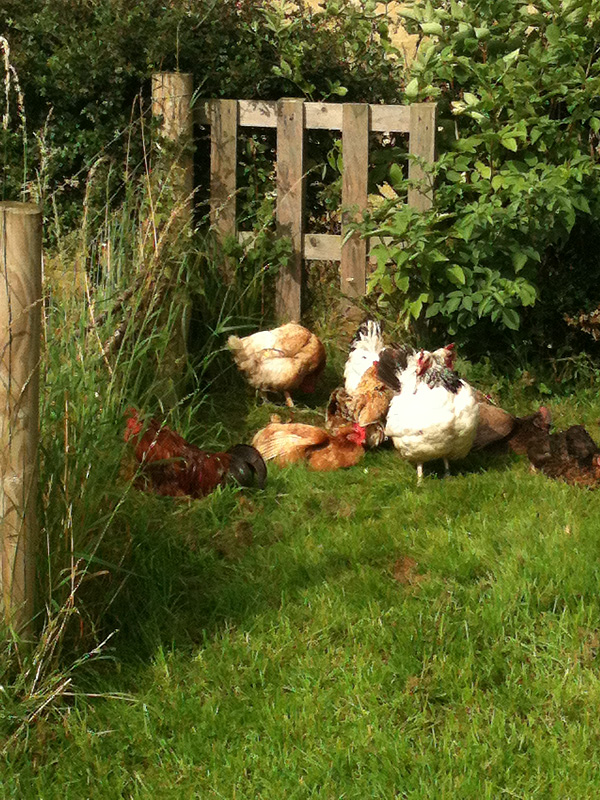
Happy chooks in the sunshine, under the old oak tree 🙂