Another Dead Tree

Another tree has succumbed – not one leaf left on it, and this year’s growth was none existent so I assume it died around the same time as the other two. We’ll replace it, a Merryweather variety, like for like, as it’s supposed to be well suited to our location, originating as it does in Nottinghamshire. I still have no idea what killed them off, but can only assume the late cold spell this winter got in to the pruning cuts.

I have also noticed cherry slugs on some of the cherry tree leaves – the larvae of a sawfly specific to plums and cherries. We have had leaves with holes in this year, so the chickens will be moved to those trees soon to scratch around the bases of the trees, after I’ve dug the ground over, to gobble up the over-wintering larvae. Other than that, it falls to us to squish any of the slugs we find on the leaves, unless we resort to chemicals.

Potato Harvest

For some reason, despite the amount of cloud and rain we’ve had this year – the good old spuds have done well, better than I had hoped, and better than our neighbours! We did manure the patch a lot over winter, I can only assume this has helped 🙂 These are the earlies (first and second) – Arran Pilot and Red Duke of York first earlies, Nadine second earlies. The Nadines were particularly scrummy – the Duke of Yorks weren’t the most prolific, but to be honest I’d pop all three of these in again next year!

As ever an escapee chook is on hand to help out with any pesky worms we might dig up…

First Tomatoes, Geese and Panoramic


Just a quick visual update. The first tomatoes are finally ready – what a slow year of growth! The geese are happily settled in and enjoying their new home, and we do have green stuff growing – including the line of spuds I’d not managed to get totally out of the ground – you can see the weeds we’ve had to leave around them in a line next to the compost bins!

Pilgrim Geese!

Finally! Part of the plan for the acre field was a grazing animal to keep the grass down, fertilise the trees, and sweep up any windfalls. According to several sources, traditionally in the East of England orchards were planted closer together and grazed by chickens and geese as opposed to pigs and sheep which was more traditional elsewhere. With our two orchard quarters we have replicated the two sizes of orchards – both the small orchard (bush trees) and large orchard (half-standard trees) will be grazed by the poultry, but the poultry will be the only animals let into the small orchard.

At the moment we are mowing like mad, especially with the current wet weather, which means the grass grows quicker and the dry spells between the downpours, which allow us to mow, are few and far between. This, along with the grass looking a decent thickness after being down for a couple of years, means the time felt right to look for an organic mower.

We looked at various breeds, and settled on the Pilgrim goose as the perfect breed. They are a relatively recent breed, from the early 20th century in the USA, but their roots most probably go back much further to previous farmyard breeds in England and France. The main feature of the breed is that they are sex-coloured; the males are white, like a smaller Ebden, and the females are a grey/olive, a bit like a Toulouse. The big advantage is that you can tell which will be your layers, and which will be for the pot, at an early age. They are also a small to medium sized goose – weighing in at about 12-14lbs when adult, so manageable if you need to man-handle them. They are also, supposedly, a very gentle and docile breed – in comparison to others. They lay a decent amount of eggs for a goose – around 35-45 a year, all in the spring breeding season, and an egg is typically 7oz in weight – about 3 times the size of a chicken egg. Frankly, I can’t really see why you wouldn’t keep geese – they lay a few eggs and eat a lot of grass, the exact opposite of the chicken which lays a lot of eggs and eats a bit of grass. But they cost a lot less when it comes to feeding them, although they do foul their bedding a lot more.

So the downside of our choice?

It turns our they’re rare. So rare they’ve just been placed on the Rare Breeds Survival Trust register. Tracking some down meant a trip to Somerset, which happily coincided with a trip to the maker of a decent plastic goose ark, their new home. Ten hours of driving, four of which were spent sharing the car with three heads all popping up sporadically from the cage loaned from Penny our Newfoundland cross, and we arrived at their new home in Merrybower just gone midnight.

They spent the night in the garage, before being carried down to their new home where they were let out. As you can see in the video – no sooner had the cage door been opened, they were eating grass – fantastic! Go my little mower friends, go!

Video of the release of the geese…

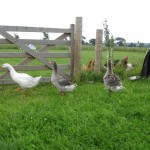
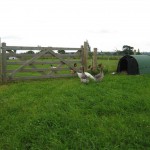
The photographs show their new pond, which we need to clean out regularly (though I’ve over-estimated how much water I can lift when it comes to emptying! Apparently Charles Atlas has no competition here, despite me weighing more than 97lbs…), and their new house – plastic and easy to clean and maintain.

Posh new house with outdoor pool

The pictures show them in a separate quarter (Penny’s quarter) from the chickens, but they were so keen to meet them we pulled the chickens’ coop into the same area. It turns out the geese just wanted to show them who was boss – not very true to breed!

We have named them Bartholomew (Barty), Lucy and Grace. Lucy is the one with a white patch on her breast. We plan to breed from them, as Barty is from different stock to the ladies, so we will have to keep an eye on Lucy’s goslings to make sure they don’t inherit her patch. Having said that, at the moment Grace seems to be the more docile one, though in fairness they are all lovely to watch. It would be nice to think we could get up to a flock size of around six, but we shalll have to wait and see where life takes us. It may be that a couple of Ryeland sheep will be the next grazers…

Well Hello Ladies

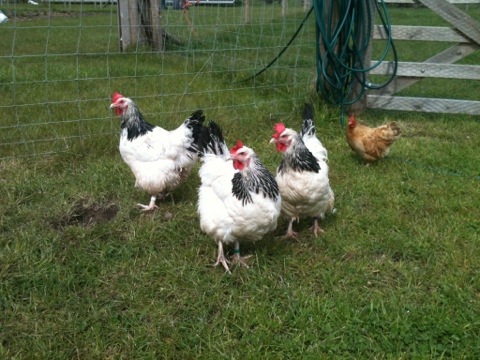
After much thought and deliberation, we have decided to move away from the hybrid layer chicken towards a pure breed flock. The reasons are numerous. Firstly, we aren’t in the business of eating our chickens or necking them when their egg production drops, so hybrids tend to produce all in the first few years, then free load for a few years (can’t blame them really I guess). Pure breeds tend to lay less per year, but lay for longer, which suits us well. Secondly, the idea of pure breeds is that should you wish, you could breed your own chicks which will be true to type, or you can breed laying hybrids yourself – basically you are independent of the breeders for your chicken supply to an extent. We decided to go for three Light Sussex, a breed introduced by the Romans to these islands. They are a utility breed, meaning they are good for eggs and/or meat should you choose, and will lay around 240-260 eggs per year. They are large birds, very fluffy, and pleasantly docile. So far, after introducing them, I have seen no animosity from them, and they seem very trusting. If we cross breed them with a Rhode Island Red cockerel we’ll end up with a hybrid layer, called a Gold Star, which will lay around 300 eggs per year – so we could keep next door in hybrid layers should they want 🙂

Meet Daisy, Lavander and Margaret.

Click for Video 1

20120424-100843.jpg

The Chicken Caravan

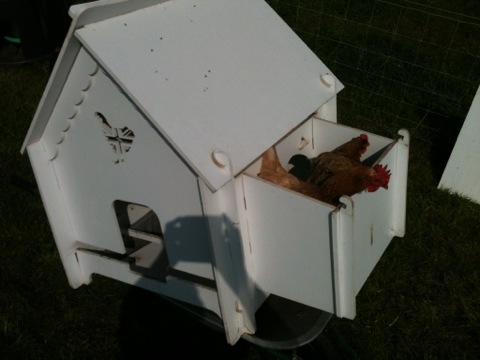
Chickens make me laugh. As part of the regime to keep our flock happy, they are shuffled every 2 months between the two orchard quarters. This means splitting the double coop in two, precariously balancing it on the wheelbarrow and moving it, complete with feathery hitch-hikers…

Click for Video

20120424-212300.jpg


Today…

…we lost Aggie, the last of our rescue chooks who joined us back in April 2009. She lived here with us for 2 years and 8 months, so was probably around 4 years old. She hadn’t been top notch for several months, but had just pulled through her last moult and looked the grandest she ever had, thanks to Suz who moved her into her p(hen)t house in the garage and fed her mash and corn regularly. Even her comb had colour back in it. Sad day indeed and the end of an era.

Meet Buffy

7 o’clock in the evening, a knock on the door.

“Have you guys lost a chicken? The ‘lady-with-three-dogs’ just asked us as she’s seen one up the lane on the bridge, but we’ve checked ours and they’re all there!”

“Crikey – hold on…” …swift count of scaley feet out the back… “Nope – they’re all there, maybe it’s Farmer John’s?”

Big worry, apart from a chicken getting squished, is a chicken causing an accident on a blind bend on a narrow lane. A posse of three would-be chicken snatchers scoot off to Farmer John’s. His are all intact.

On the bridge there’s Brett and his dog, being eyed by the chicken, it’s a stand-off. Pants – the chicken is a young cockerel – no use for eggs, but still, it’s an animal and it’ll never survive out here with the foxes around at the moment. Let me tell you, it takes 4 adults, one big black dog and ‘a lot’ of corn to coax, guide, tempt a hungry cockerel into a box. We’re stuck with him – and needless to say when he woke up in his new home, surrounded by 9 unsuspecting hens, he probably thought he’d died and gone to heaven 🙂

Fennel & Chicken Worming

We have space in the patch – how dare we! The onions planted last year and harvested this spring left a gaping hole, so we’ve popped some fennel in. No idea how to cook it but there you go 🙂

As of now, we’ve never wormed the chickens, and just relied on the addition of cider vinegar to their water, and Verm-X added to their feed. I’ve decided to worm them properly, and have added 6g of Flubenvet to 2kg of their layers pellets. I’m amazed at how little Flubenvet is needed, it must be potent stuff, but apparently you can still eat the eggs. We need to feed them this mix for 7 days, and then repeat it every 6 months.

Poor Chook :(

Today we lost Snowy, the foster bantam. She passed away in her sleep and is now in the orchard – it’s going to be much quieter without her special sqwawking.