As so often happens here, we don’t so much as choose an animal as it chooses us. I happened to call in on some friends, Pete and Rob, this morning, to chat about incubators and geese as you do, when as I left Rob asked if I’d like to see his new  Rhode Island Red hens he’ll be breeding from this year. Always keen to have a gander I followed him out to the array of pens. Lovely looking things, but it turned out Rob had decided to concentrate on the RIRs and his escapologist flock of Derbyshire Red Caps, so did I know anyone who would like three Andalusian pullets and a Light Sussex bantam? Needless to say, 10 minutes later ‘Freebie’ was acquainted with William and her new flock 🙂
The second newcomer is called Velveteen. Suz’s not so sure, but I think we first met Velveteen last spring, when we noticed a hare or rabbit had been nibbling the orchard tree trunks. Once the allotment had been sown with peas and beans, her diet moved from tree to green shoots. Later it progressed to sunflower seedlings, around 30 of them to be precise, half our sunflower bed! We tried a few things including electric wire (she bounced through it), so resorted to wiring over every new seedling – not a quick task. Every year seemed to throw something new at us – the year previous was slugs, before that white fly, before that rats, before that pigeons. Add to the mix voles, moles, green fly, black fly and saw fly, it was a surprise rabbits hadn’t appeared before! In fact it wasn’t really a surprise – this side of the canal bridge we tend not to get rabbits. They seem to prefer the hill side to the north, not the wet lowlands here. We do get hares, hence the outlay 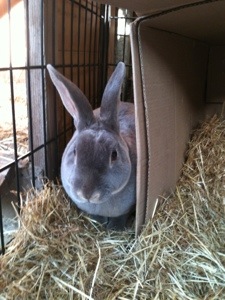 on hare guards for the orchard trees, but we’d removed those this year as we’d seen none come through the fencing. However, No.1 cottage has been empty for over a year, and the garden which had previously been patrolled by Pete’s spaniels, Lady and Darling, was now the only open gateway to our patch, unguarded as it was. A few weeks ago we’d noticed the return of Velveteen, hanging around ‘the barn’ (a shed but I have delusions of grandeur) chewing dead asparagus leaves and grass. Two days ago I walked towards her, but she just looked at me, chewing. I moved closer, about 10ft distant, and she plodded a few yards away, to continue munching her mouthful. This continued for five more minutes, each time I managed to get closer. Eventually I was within arm’s reach, holding out my mobile phone, recording proof that I was, indeed, the new Rabbit Whisperer. Kudos was mine that evening when I showed off the video to the family if me chasing a wild rabbit around the allotment. Yesterday she was back, same place, but this time Suz had placed a bowl of carrots down, and Velveteen was happily munching her way through them. I herded her into the bantam enclosure, only for her to escape whilst I grabbed a quick breakfast. This afternoon she was back (more bait was down) and both Suz and I managed to finally capture the wild rabbit of Merrybower. But, as Suz had suspected, and the ability to drink from a bottle drinker confirmed, Velveteen was, in all probability, a stray domestic rabbit. Her coat was beautiful, big brown eyes, and a penchant for being tickled on her cheeks. So here she is now in Penny’s spare dog-crate, awaiting a visit to the vets before deciding if we can keep her (or him), though I suspect there’s no question really. And I’m also glad that the new rabbit explosion this side of the canal has been dealt with, and I can go back to worrying about pigeons, and slugs, and various flies…


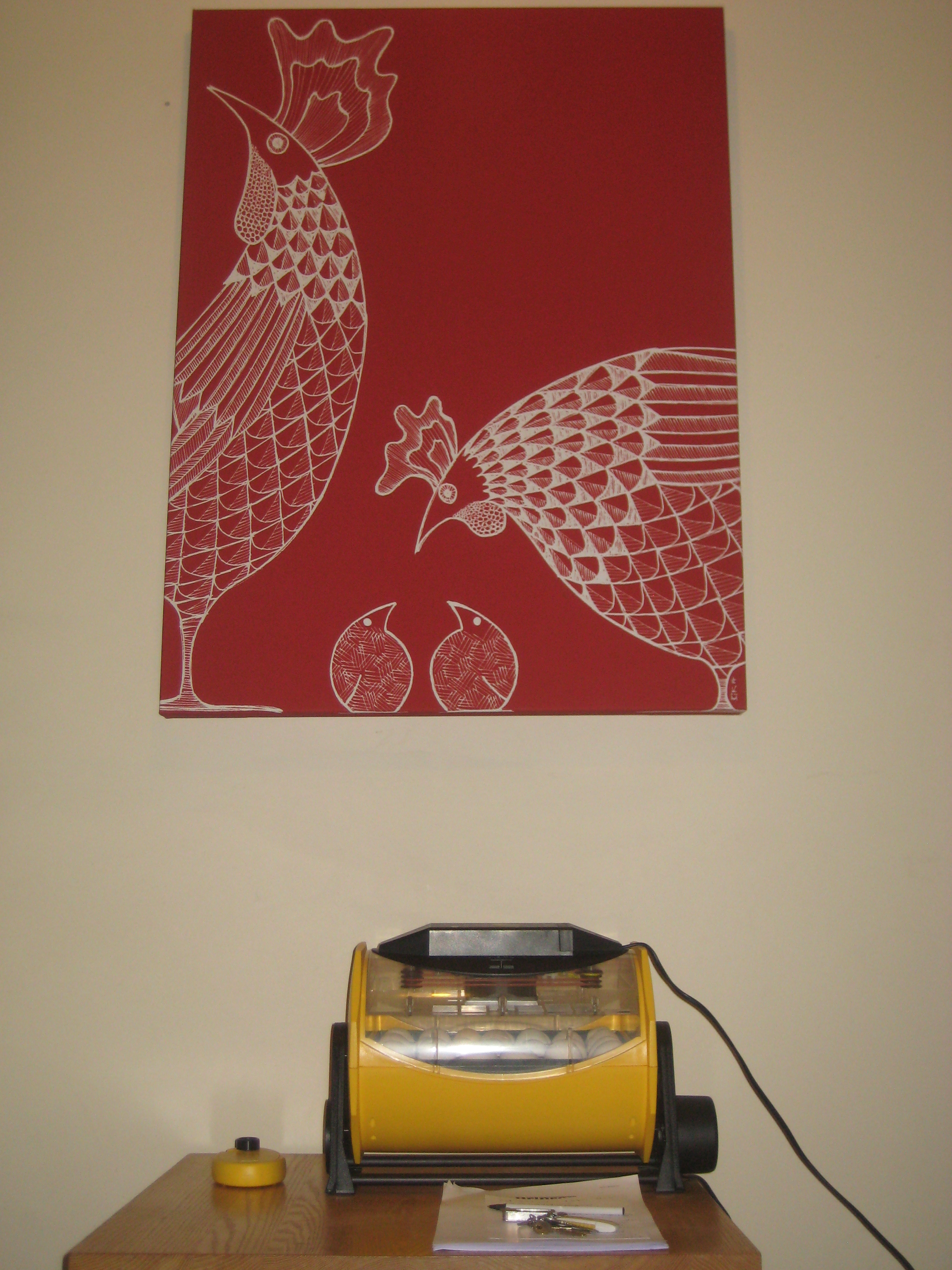 Finally it’s the time of year when we can begin our first incubation of hen’s eggs. As our large fowl Light Sussex flock is the thinnest on the ground, with only Daisy and Charles left, it was time to begin with Daisy’s eggs. We’re using the Brinsea Octagon 20 Eco incubator with an auto-turn cradle. This model doesn’t regulate the temperature digitally, nor does it control the humidity. However, we’re going to keep the mercury thermometer in the incubator at around 37.5 Celcius, fill one of the water channels as described in the manual, and close the ventilation hole by one third (so two-thirds open). When we’ve reached day nineteen we’ll candle the eggs – any still clear will be discarded, any solid will, in theory, have a chick developing inside.