Photo Update
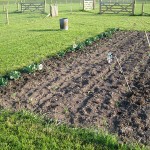
Just a few pics of how the patch is looking now, after several weeks of hard work by all the family.

Just a few pics of how the patch is looking now, after several weeks of hard work by all the family.


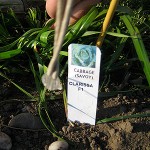
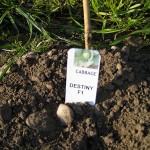
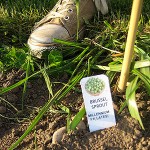
 Up to and including this year we’ve bought our brassicas as small plants, rather than grow them from seed ourselves. It was a way of lowering ourselves into the grow-your-own pool slowly, as there’s so much to learn and do! This year is the same, but we’re still learning, and things just seem to have run so much easier this year. The weather’s helped – plenty of fine days to work the ground and sow stuff, followed by timely rain. There’s less to do to the land in the patch – weeds have been nobbled in the grass quite well by continual mowing and grazing last year. The fences are in, the trees planted, bushes in, a water supply is in; a rhythm to the patch is becoming audible.
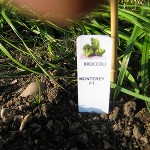
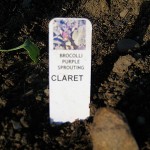
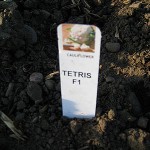
So today I popped into the local nursery to buy the brassicas we need. We have a line of spring cabbage already in from last year, and to this we’ve added the following:




Strawberry patch
We’re discovering that this is one of the busiest times of the year – the ground is warming up, the sun is out and literally everything is bursting into life. The lambs are bouncing around the paddock, the snap peas and beans planted a few weeks ago are popping up, the sweetcorn on the children’s windowsills have grown about 2″ in less than a week and the weeds…well, let’s just say they’re doing fine.

Asparagus bed
The mulching idea on several areas of the patch seems to be working – manure on the strawberries, grass cuttings on the asparagus, home-made compost on the spring cabbage and winter onions. But the bits of naked earth are a prime target for anything unwanted to
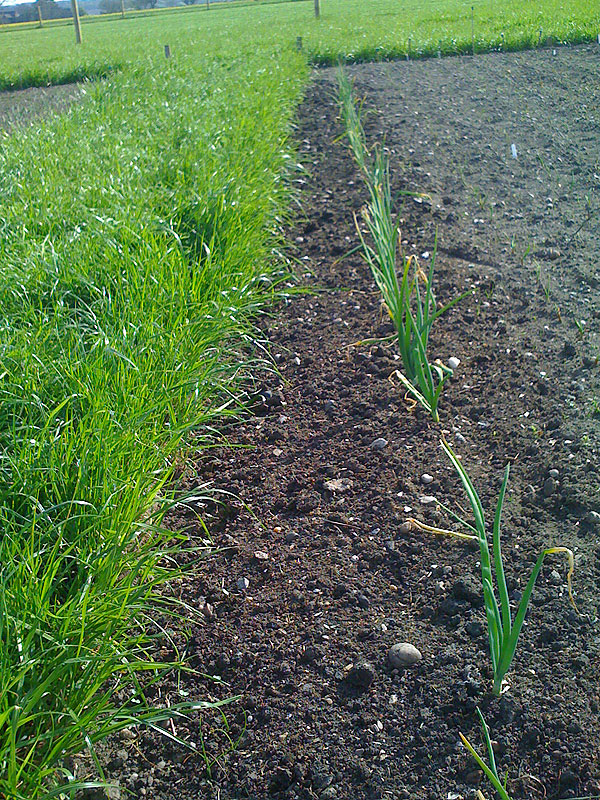
Winter Onions
try and take root – we seem to have nobbled the chickweed quite well from last year – nowhere near as much at the moment. Likewise with the Shepherd’s Purse, though the wild pansies seem to be quite tenacious. So this weekend has seen a lot of hoeing, but it’s been quite easy as we’ve all been doing it regularly and the soil is quite crumbly now.
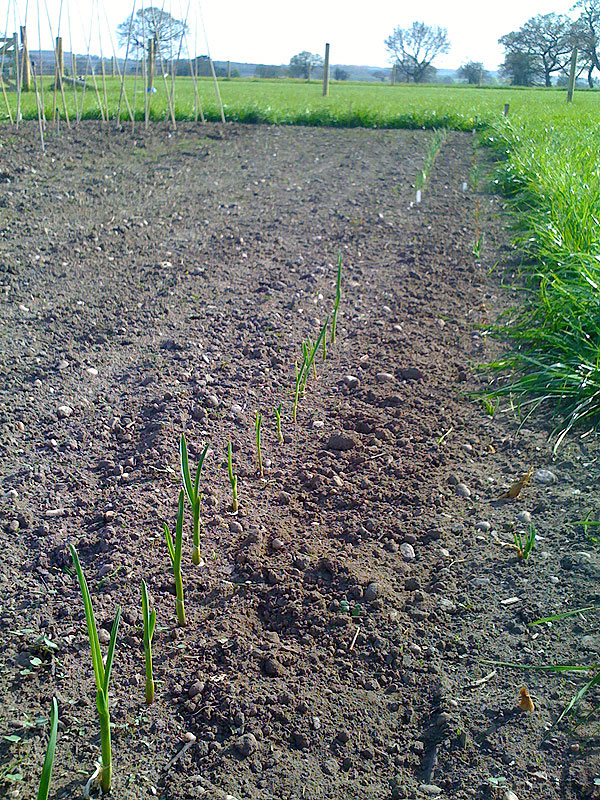
Garlic
Life in the allium patch is running amok – the garlic is shooting nicely – well, one variety of them, the other is still sleepy. The shallots have their familiar fluffy tops on them where the multitude of stems are visible from one shallot. They always remind me of a muppet hairdo at this stage. A few onions have been uprooted by a ne’er-do’well – probably one of a feathery persuasion.
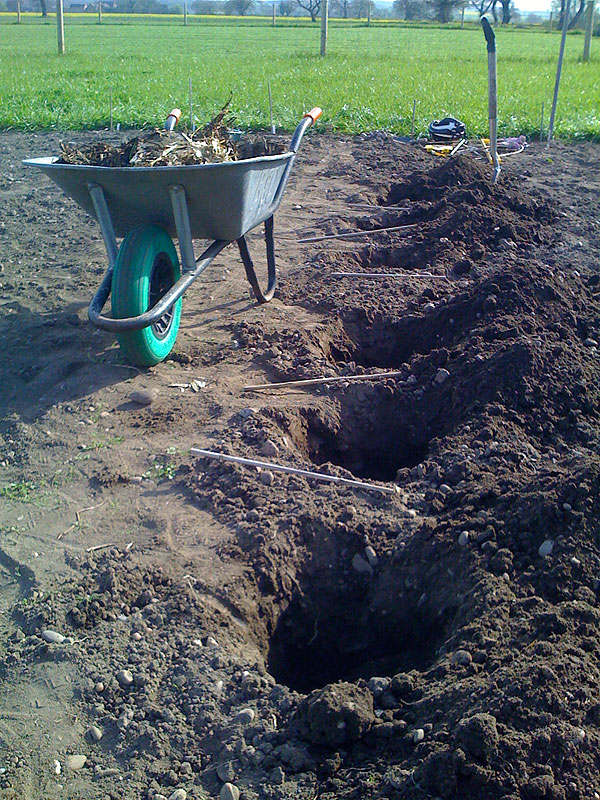
Courgette & Squash stations
We’re also trying something new this year when it comes to the courgettes (F1 Zucchini) and butternut squash (F1 Cobnut) – left overs from last year. Holes are being dug for each plant, and in the base some well-rotted manure is being added. Then the soil is replaced, forming a little tummock for each plant to sit upon.
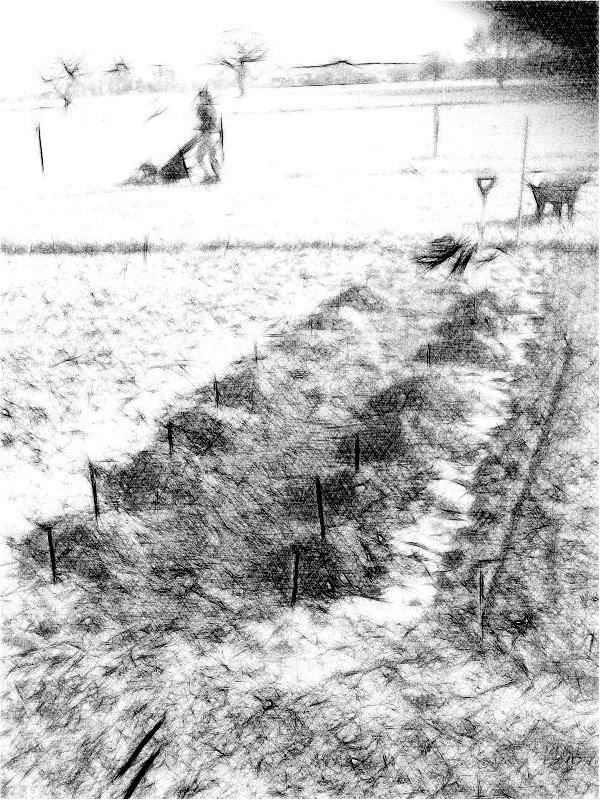
Courgette tummocks
No idea why it works as this stage, but all of the books and websites I’ve been reading suggest doing this so here goes! We must remember to mulch around the base of the plants once they’ve been planted. At the moment all of the squash and courgettes are sitting in the mini greenhouse in their own 3″ pots. There’s no denying that the finished mounds look tidy.
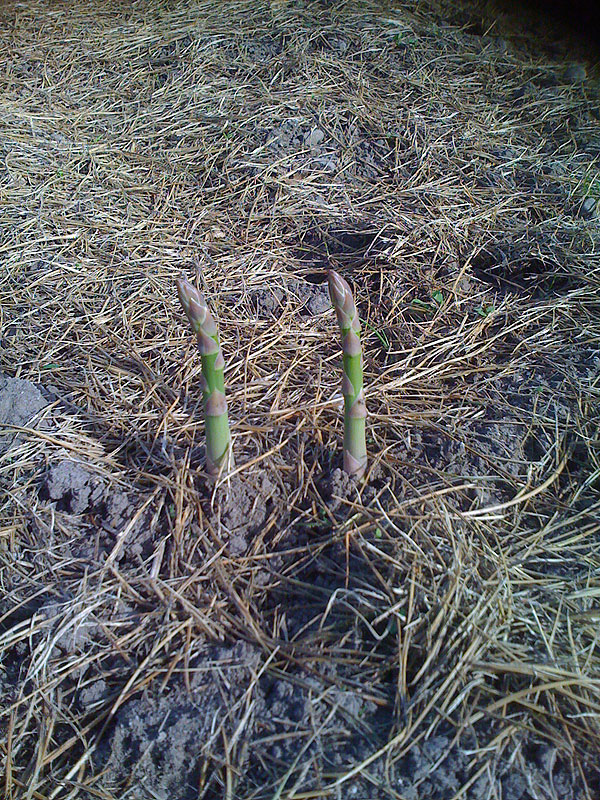
Asparagus
On a final note, up until a few days ago we had one asparagus in the asparagus bed. This is one of the most exciting veggies for me personally. I love them…Suz loves them…so imagine our disappointment when only one showed up! Then, when another came up, the original disappeared! I’m guessing an unwanted visitor must have nibbled it, but today we found about 8 spears waiting for us – one of them about 14″ tall! Most were still quite tiny, and I’m not sure if we should pick them this year – but in the most appropriate words of Young Frankenstein – “It’s alive!!”
This weekend also saw the grass cut in the whole patch for the first time, more mulching around the bases of the orchard trees, and the first pruning of the plum and cherry trees. We also mowed one of the headlands, where many Shepherd’s Purse flowers were happily growing. I’m not sure if mowing at this time will kill any wanted flowers that may be there, but the cutting is an attempt to let some light into any wanted flowers that may be struggling to see any light. We’ll soon see if this has worked.
Last but not least, we sowed the first row of beetroot – Cylindra. We’ve not tried this variety before, but I hear it’s good as a salad variety. We’ll sow the F1 Kestrel variety that we sowed last year later in the year, for storage.
Another good day in the patch. We all trooped down, the sun decided to make an appearance, and for a short while you could almost convince yourself that winter was over. The first and second early potatoes (Epicure and Kestrel) were dropped into their waiting 6″ deep holes – spaced 12″ apart in rows 18″ from each other. As they start to show in a few weeks we’ll mound the earth over the tips to protect them from any frosts we might get.
An awful lot of hoeing was also done – after last year suffering some consequence of perhaps not enough, I’m determined to keep on top of the weeds at this time of year. So the potato patch was hoed thoroughly before planting the seed potatoes, the legume patch got a good seeing to as well, as did the brassica patch.
The Jerusalem Artichokes are already popping their heads above the parapet, but whilst they’re still quite short, we sowed some lettuce between the rows – Balmoral (a type of iceberg variety) and a Salad Lettuce, pick as it grows type. The radish in the parsnip row are already growing, and the snap peas, peas and broad beans are starting to show.
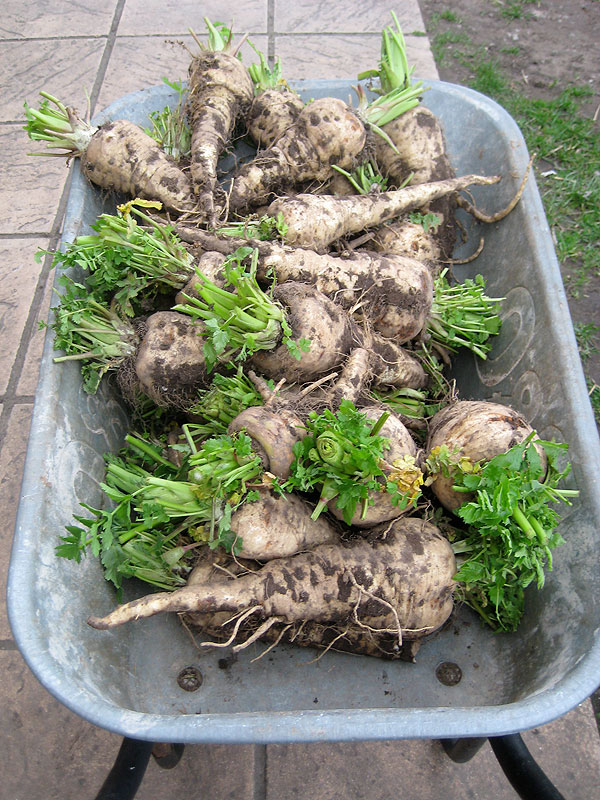 Whilst Jay was planting the potatoes that have been on her windowsill for the last 6 weeks, Suz and Smiler dug the remaining parsnips up from last year’s crop. They managed to fill a barrow full with about 15 parsnisps – they are giants! We had 2 between four of us for our evening meal in a parsnip soup, which also used our own leeks, onions and garlic, and cheese and yoghurt added. It tasted fantastic, really welcome after working outside all day.
Some twitch was also dug out from around two of the orchard trees. They look like isolated events, but the fact that twitch was present means it was in the field before we sowed the grass, so a beady eye is needed.
The last thing to do was to sow into large 6″ pots the chilli seeds. We’ve used the remainder of last year’s packets – Peperone Dolce di Bergamo and Pimientos de Padron. Again, these are in the mini greenhouse for now but will be moved to the main greenhouse soon. The sweetcorn that was in the mini greenhouse have been moved to Jay and Smiler’s windowsills now that their potatoes have gone into the ground.
Jay also grabbed her wild flower books to try and find out what sort of flowers were showing themselves in the headland where we’d sown the wildflower mix. It turns out that the flowers present are nothing to do with  the mix, but were already in the soil. We have:
Shepherd’s Purse (Capsella bursa-pastoris) – is not native to the UK, but comes from Eastern Europe and Asia Minor. In Shanghai it is commonly used as food, where they stir-fry it with rice cakes and other ingredients, or as part of the filling in wontons. Herbally, it is primarily used to stop vaginal bleeding, an action which may be attributable to the common parasitic 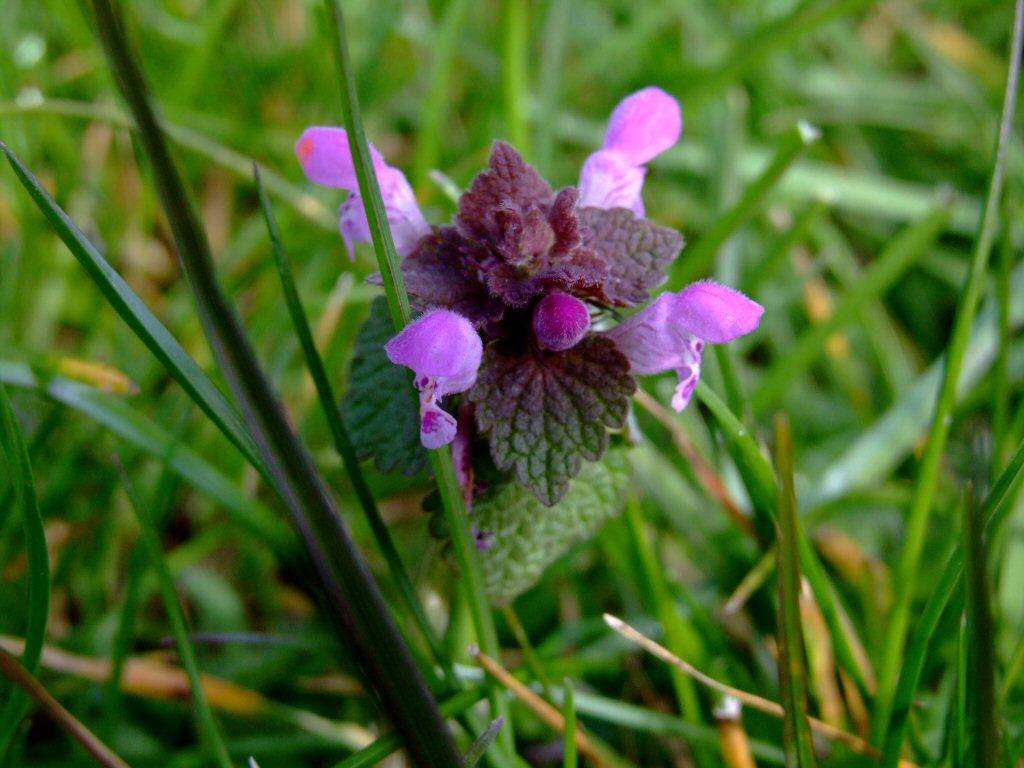 fungus found with it.
Red Deadnettle (Lamium purpureum) – a prominent source of pollen for bees in March/April when bees need the pollen as protein to build up their nest. Young plants have  edible tops and leaves, good in salads or in stirfry as a spring vegetable.
Germander Speedwell (Veronica chamaedrys) – a good source of nectar for solitary bees, it is a common flower in woodland, hedgerows and gardens and in the past was used in herbal  medicine to treat coughs and catarrh, and as blood tonic.
Common Chickweed (Stellaria media) – is edible and nutritious, and is used as a leaf vegetable, often raw in salads. It is an annual plant, native to Europe, and often eaten by chickens (hence the name). It is also called chickenwort, craches, maruns and winterweed.
Wild Pansy (Viola tricolor) – also known as Heartsease, is common to Europe, and grows as an annual or short-lived perrenial. In the past it has been recommended as a treatment for epilepsy, asthma and eczema, and has also been used in the treatment of chest complaints such as bronchitis and whooping cough. It is also a diuretic, leading to its use in treating rheumatism and cystitis.
Heartsease was a staple in medieval gardens, and was once believed to be a potent love charm. Its flowers are an old remedy for heart disease, and an infusion of the herb was reputedly the cure for a broken heart. Heartsease contains salicylates and rutin, both of which are anti-inflammatories, and may explain the herb’s ability to calm skin inflammation.
 So far the year has been fantastic weather-wise, especially compared to last year. We’ve had rain, sun, rain, sun, and the last spell of sun has meant that we really needed to get on top of
 the grass which is growing like billy-o! We’re using the grass clippings to mulch around the base of the orchard trees to supress weeds – only about 1″ thick at a time until the clippings brown off without turning to sludge, then we’ll add more. I love this time of year – the winter drudgery is on the way out, things are beginning to look greener and order is returning.
Last year we planted the sweetcorn directly into the ground in May once it had started to warm up, but unfortunately they were too small to eat. This year, though the big greenhouses aren’t ready yet, I’ve sown the sweetcorn into 3″ pots and popped them into the mini greenhouse. They need to have a temperature of 15C to germinate, so even that might not be enough, but with the potatoes happily chitting away on every spare windowsill there’s no space for them inside. At least we’re buying an extra month.
I also sowed the leeks into trays of compost. Again, these are starting off in the mini greenhouse, but will be transferred to the main greenhouse once we’ve finished building it!
The sweetcorn we’ve sown are Incredible F1, and the two types of Leek are Lyon 2 – Prizetaker and Autumn Mammoth 2 – Snowstar.
Okay, by now I admit it must start to look as though we’re a bit geeky for onions. But there’s no point denying the fact that today we sowed three more 30′ lines of onions. Two rows were of Bedfordshire Champion. According to the packet they’re ‘heavy cropping’ and ‘long storing’. If this is the case then these will be the ones to keep us going over next winter, so fingers crossed that they’re a good choice.
We also added a row of an Italian mixed variety, called Tris di Cipolle, another good storer. These are a medium sized onion, with a mix of white, brown and red skins, so something else to look pretty (apart from yours truly) once grown to a decent size.
We use a 5 bed rotation system for our veg, just to try and keep any nasty veg bugs at bay. In true style, when marking out the 5 equal beds, one of the beds ended up decidedly larger than the rest so it has been elevated to the ‘cash bed’. We plant/sow more than we need, and the spare get sold on the front. Last year’s ‘cash crop’ were potatoes, which we’re still eating, and this year’s is going to be O’Nions.
Shallots last year seemed to go down quite well on the front, with home picklers, so this year we’re putting a fair few in. We’re also going to sow onions from seed – I’ve no idea how sucessful it will turn out, but you never know until you try.
Todays plantings are:
Yellow Moon Shallots – disease resistant
Red Sun Shallots – good salad shallots
French Garlic Arno
French Garlic Cledor
This means we’ve filled nine 30′ rows of onions, shallots and garlic, and there are another five to fill. Two will be for leeks, the remaining three will be with the onion seed.
 With the sun continuing to beat down on us – it must be over a week now of glorious sunshine – and it set to continue on to the weekend, it’s time to make the most of the warmth. Suz and I plodded down to the patch to set the following onion sets:
Sturon Onions – good for storing
Centurion F1 Onions – early cropper
Karmen Onions – great red salad onions
Picasso Shallots – good pickling shallot
Golden Gourmet Shallots – mild tasting and excellent pickling shallots
Sowing started today, in earnest. The packs have been ready to plop in the ground for a while now, the onions have been sat in the garage, and this week the sun decided to show itself for a 4 day stretch, so we’re earmarked them as the time to get a heap of seeds sown.
As usual, more hoeing before sowing, just to try and rid us of as many weeds as possible. Then these were sown:
Kelvedon Wonder Peas- will sow more in April and May
Bunyards Exhibition Broad Beans- will sow more in April and May
Norli Mangetout- will sow more in April and May
Gladiator F1 Parsnip – sowed the radish in the same drill to mark the row
Chantenay Red Cored 2 Carrot – will sow more in April and May
Prinz Rotin Radish
Whilst the parsnips are hybrid F1 types, meaning we can’t save the seeds and reuse them as they won’t be true to type, next year’s seeds will come from last year’s crop, which is true to type. We’re also going to try and start buying our seeds from these people – https://www.stormy-hall-seeds.co.uk/