Posts

2024 Cider Making

Apple Picking

Apples Galore!
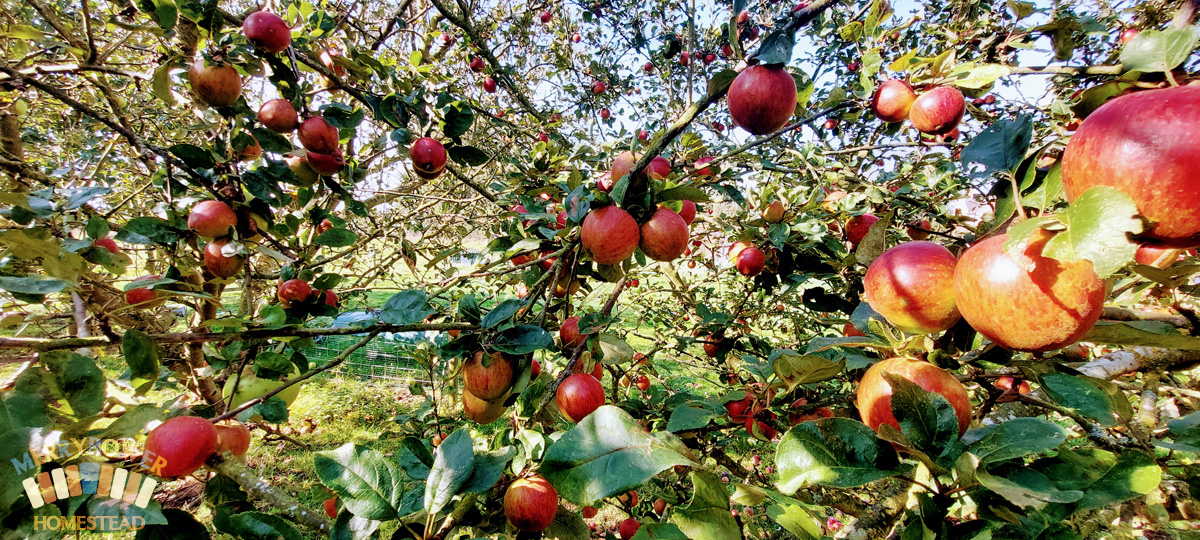
Apples Galore!

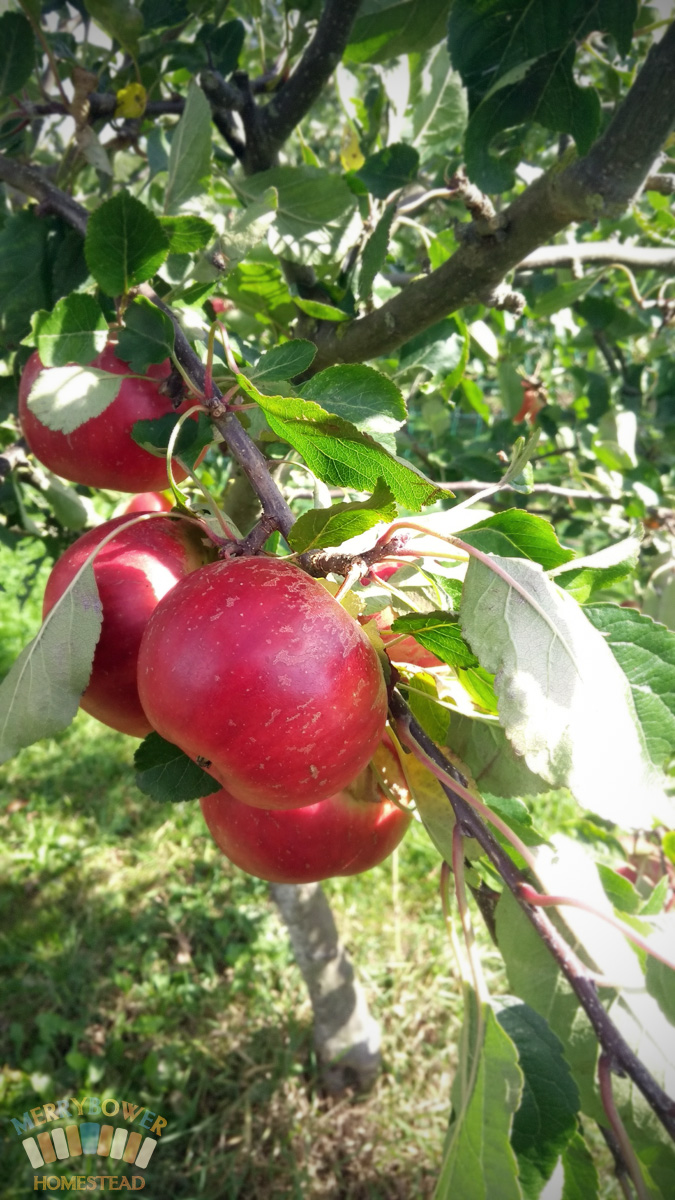
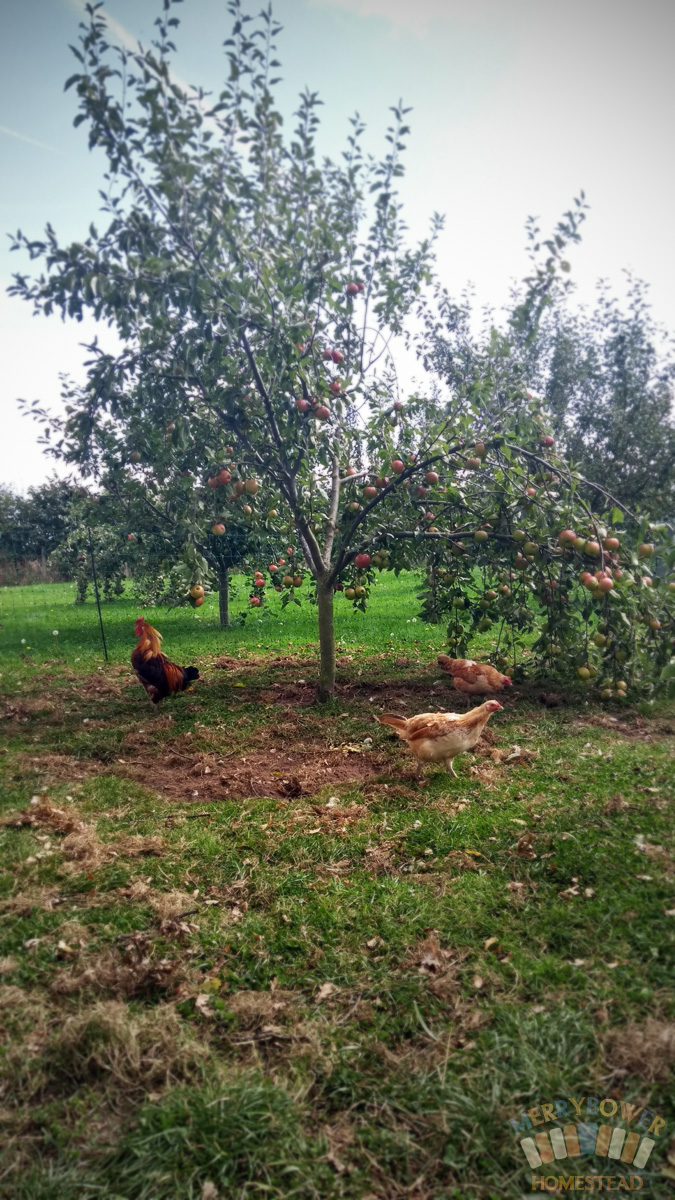
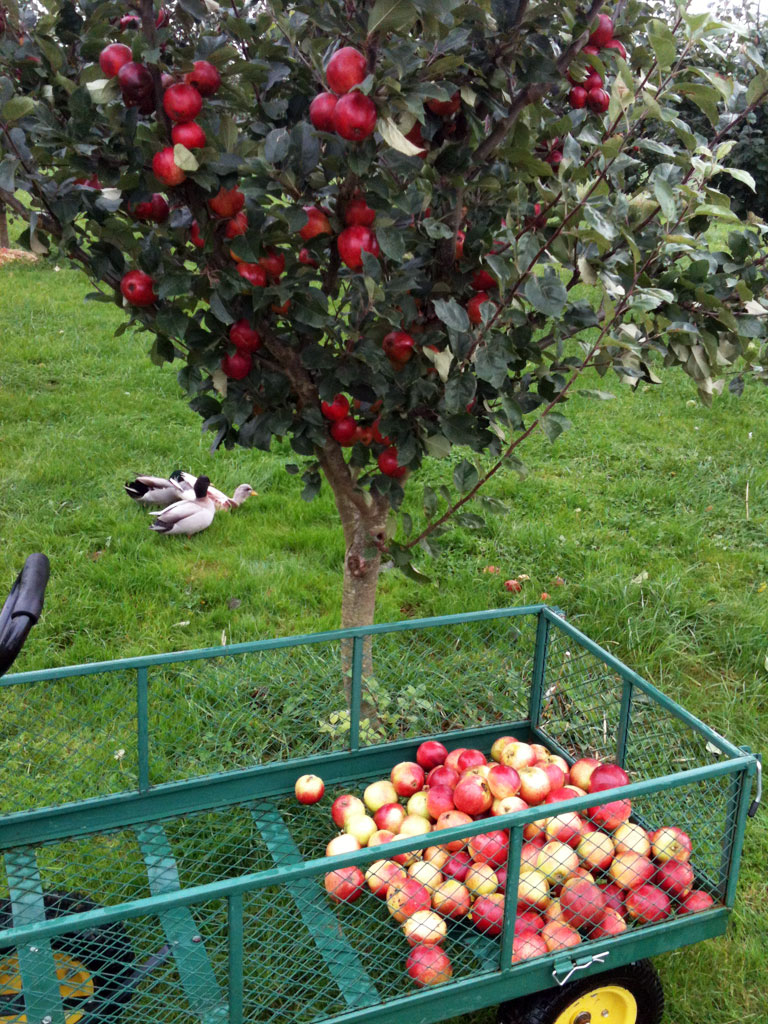
Sitting in the Dabinett tree

Sitting in the Dabinett tree

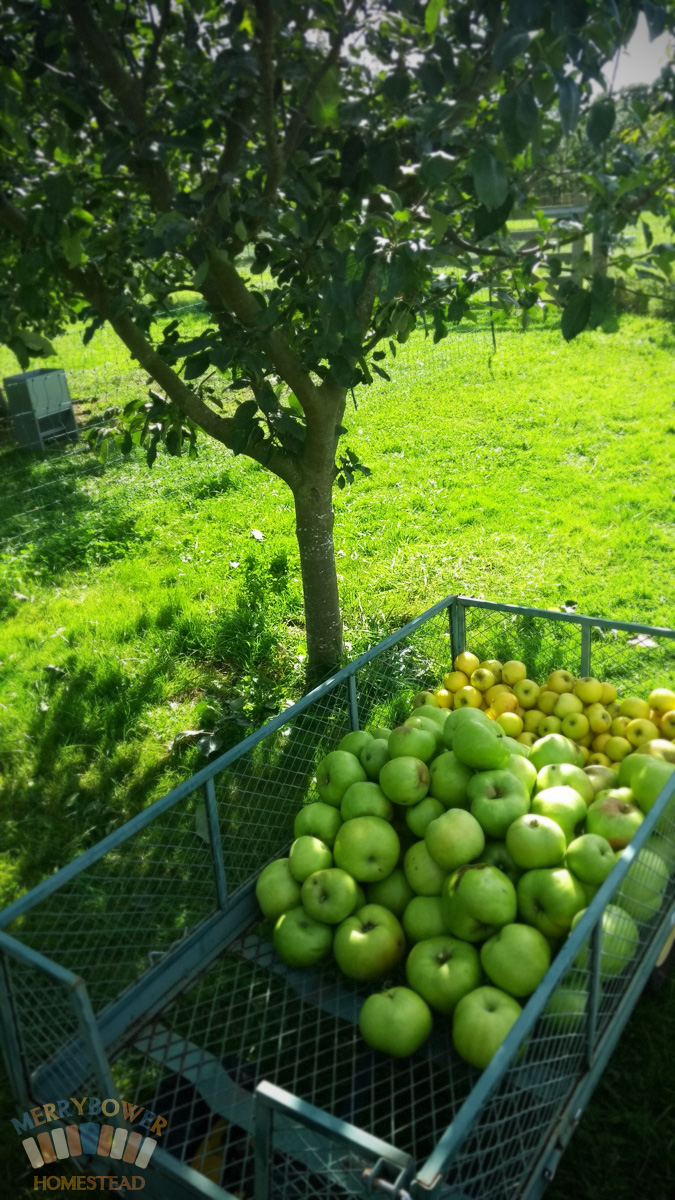
It’s that time of year! The leaves are starting to fall in the orchard, the sun sits lower in the sky, for a shorter length of time.

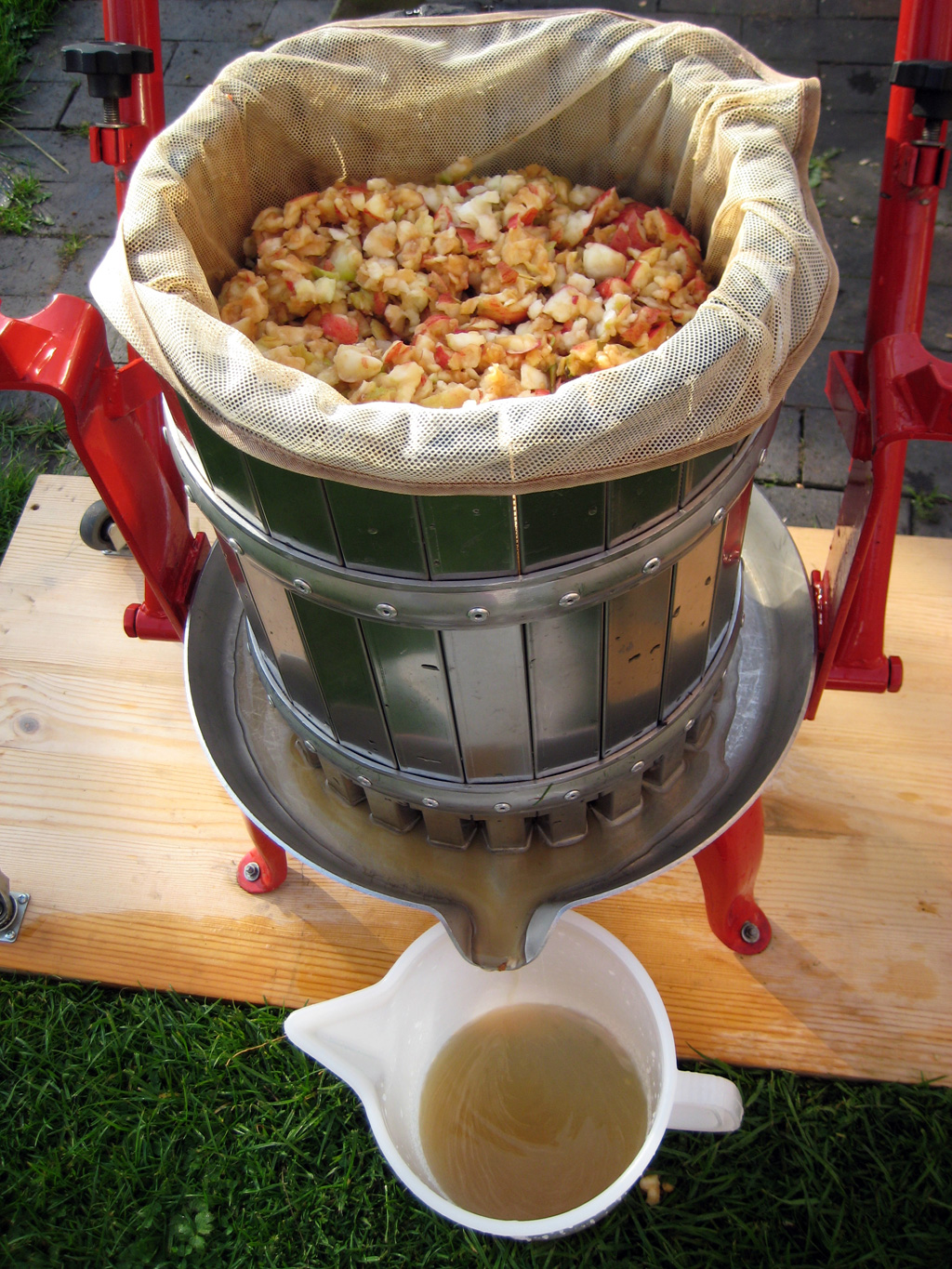
And the apples are starting to drop.  Just one pressing is planned this year, life is so busy in other regards, but it was great to pull all the kit out, having not pressed anything last year!

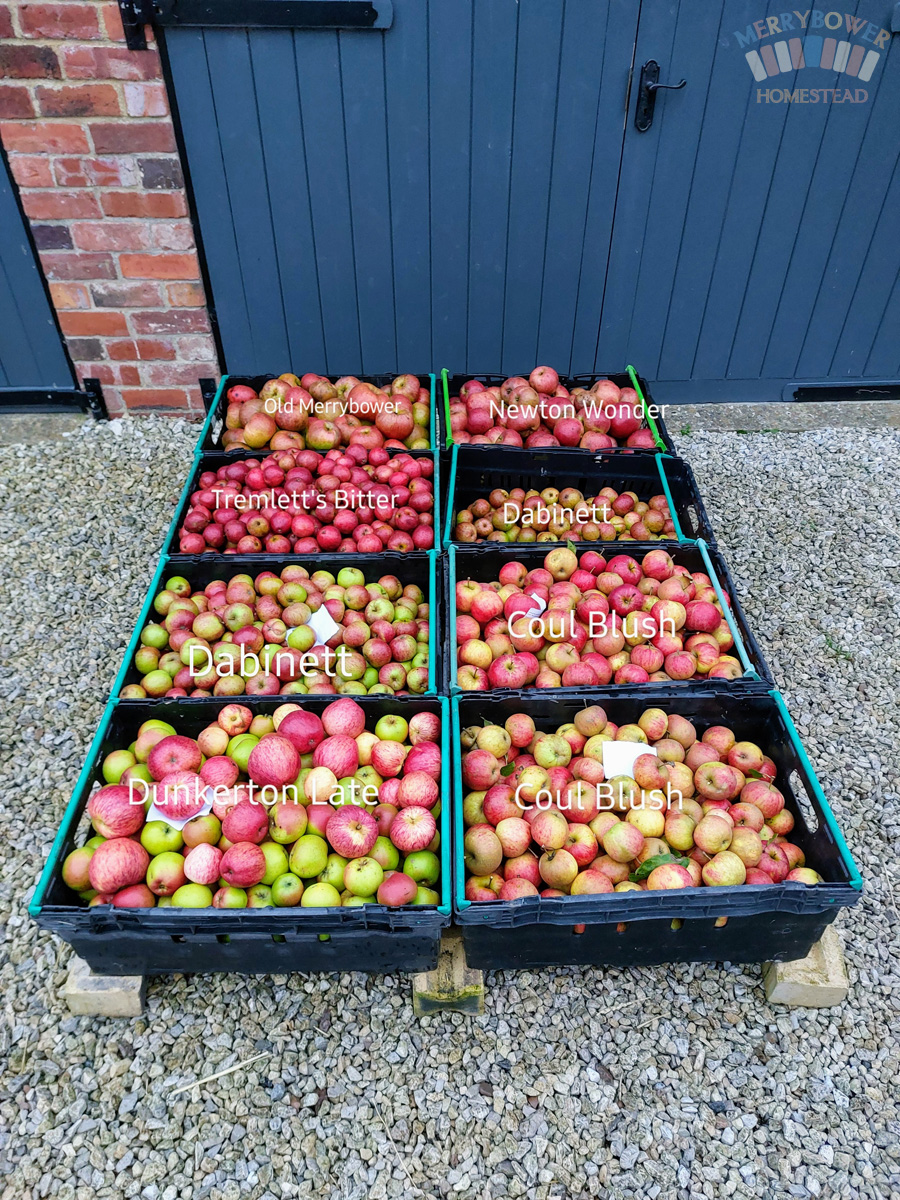
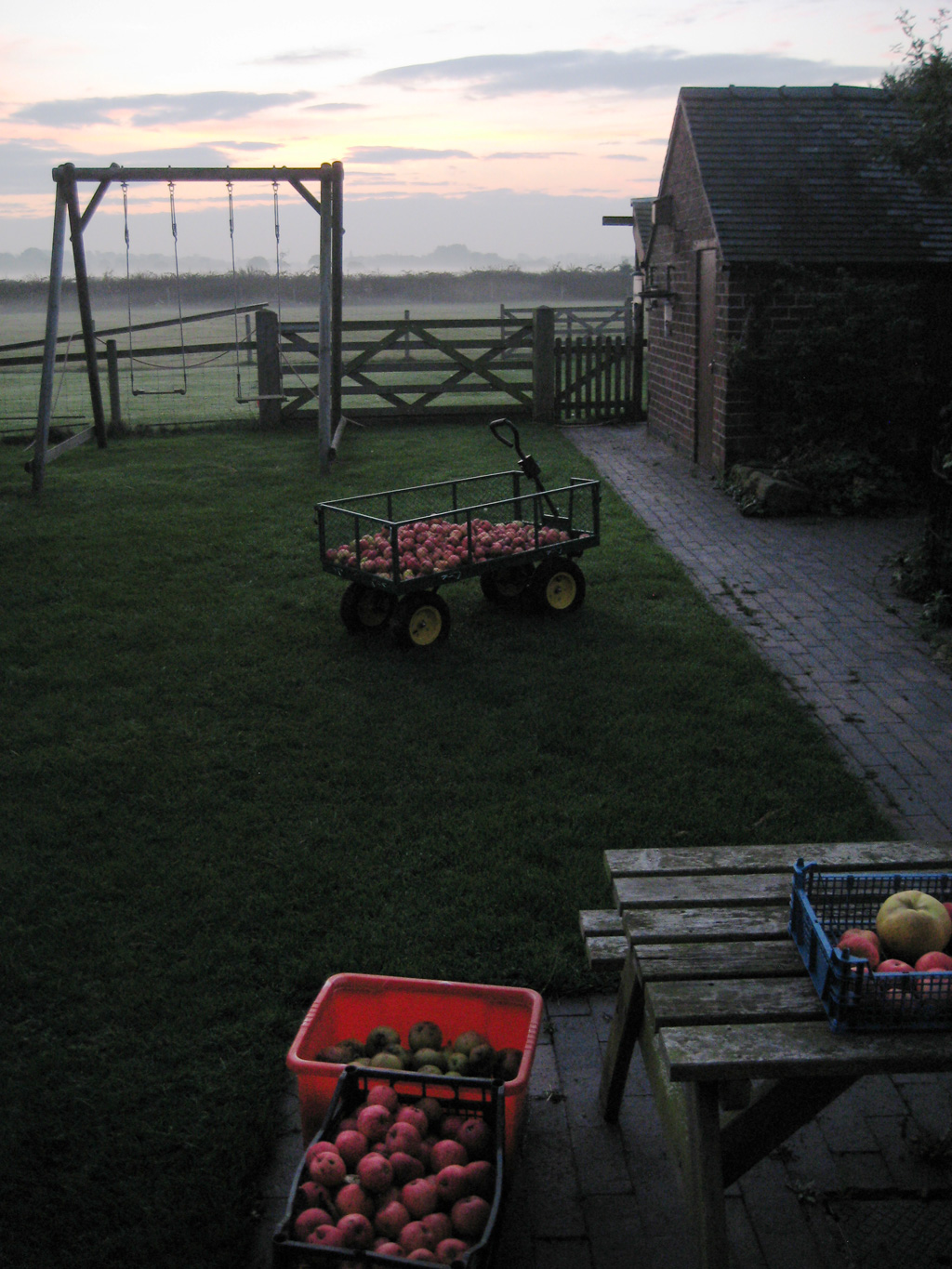
Finally three of the cider trees planted years ago are finally fruiting enough to make use of their bounty, so Dabinett and Dunkerton Late were added to the mix. Tremlett’s Bitter was also picked, but in the end it didn’t have the bite I thought the mix needed – Dabinett pipped it in that regard. All are sweet, but the Dunkerton Late (picked because it’s sweet, and it has ‘Dunk’ in the name) is just pure sweet – no bitter, no acid, just an apple-shaped blob of sugar! As usual, they were picked and left to ‘sweat’ for a couple of weeks, to give the starch time to break down.
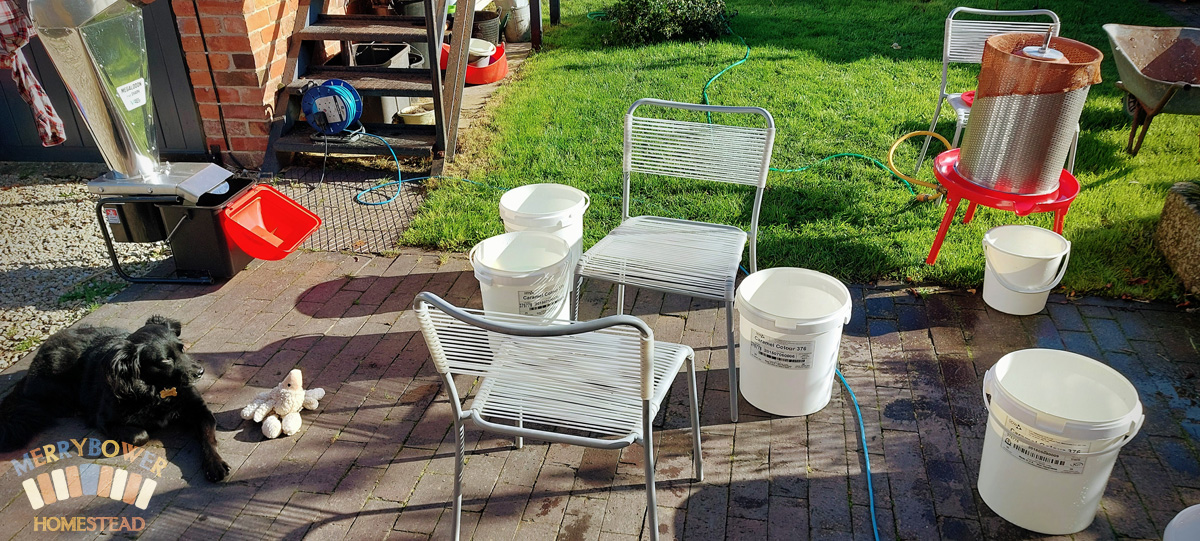
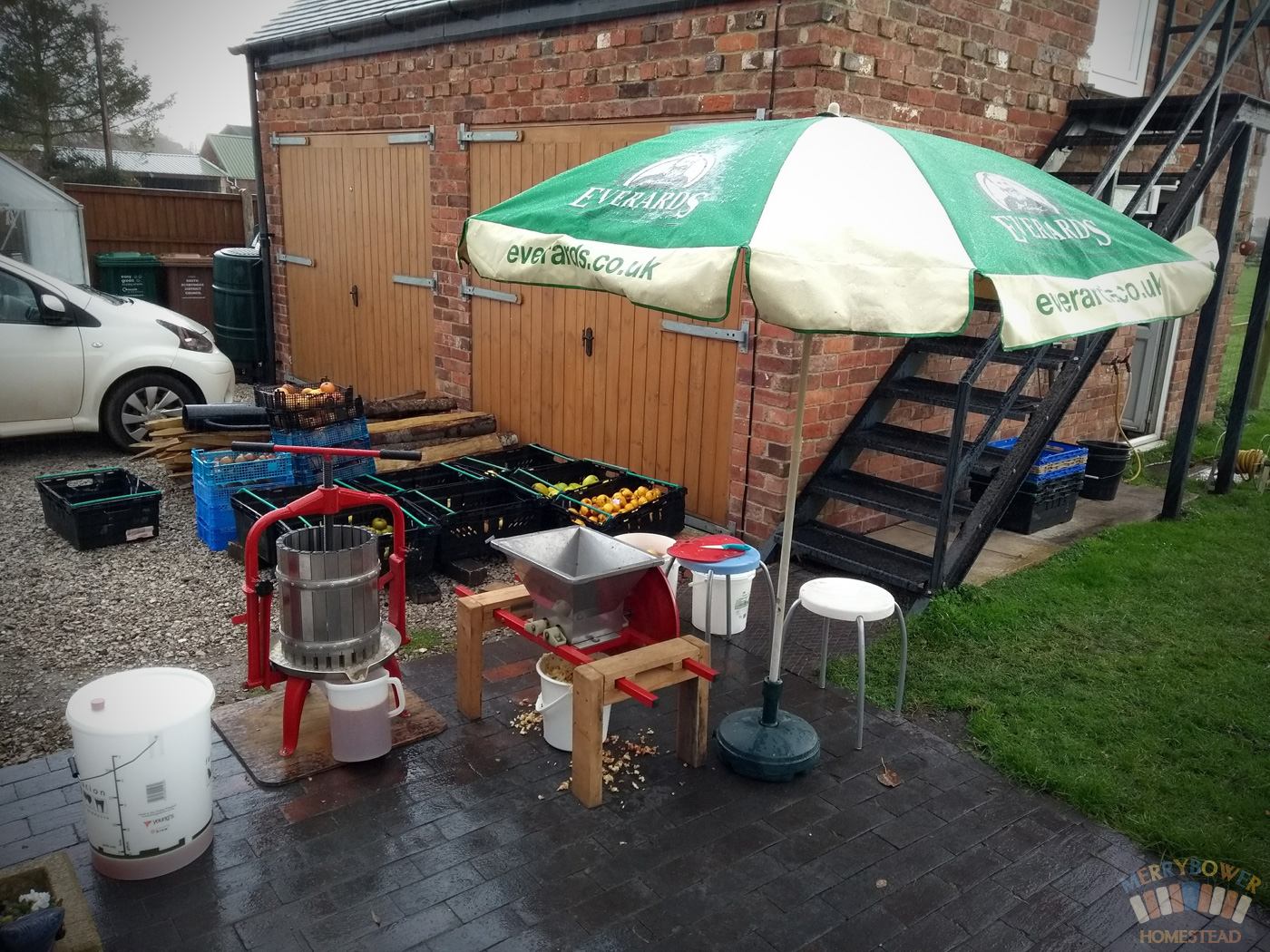
All the gear, a modicum of idea

All the gear, a modicum of idea

This year I was joined by Sasha, the new member of the family who stumbled across us earlier this year. I’m still not sure she was much help, but she assures me that motivational presence is a thing.
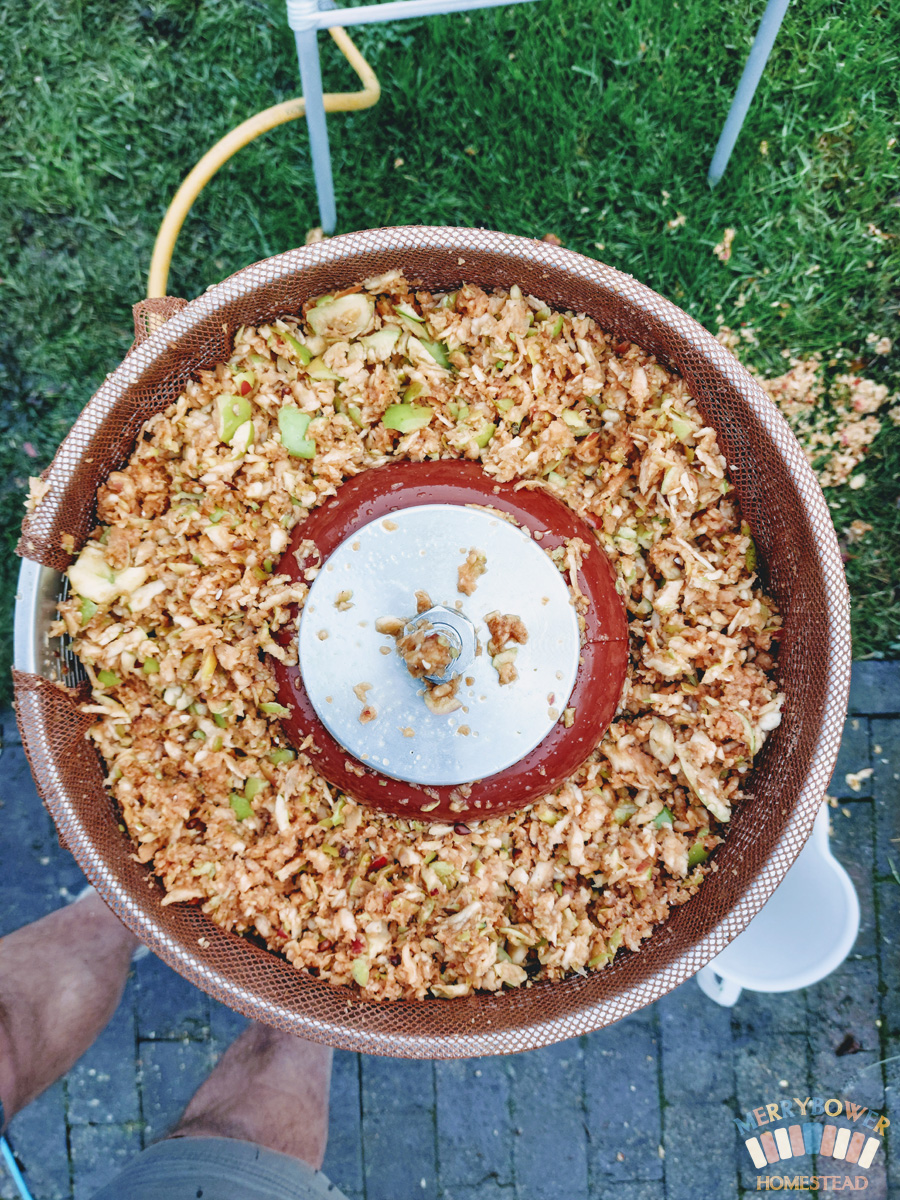
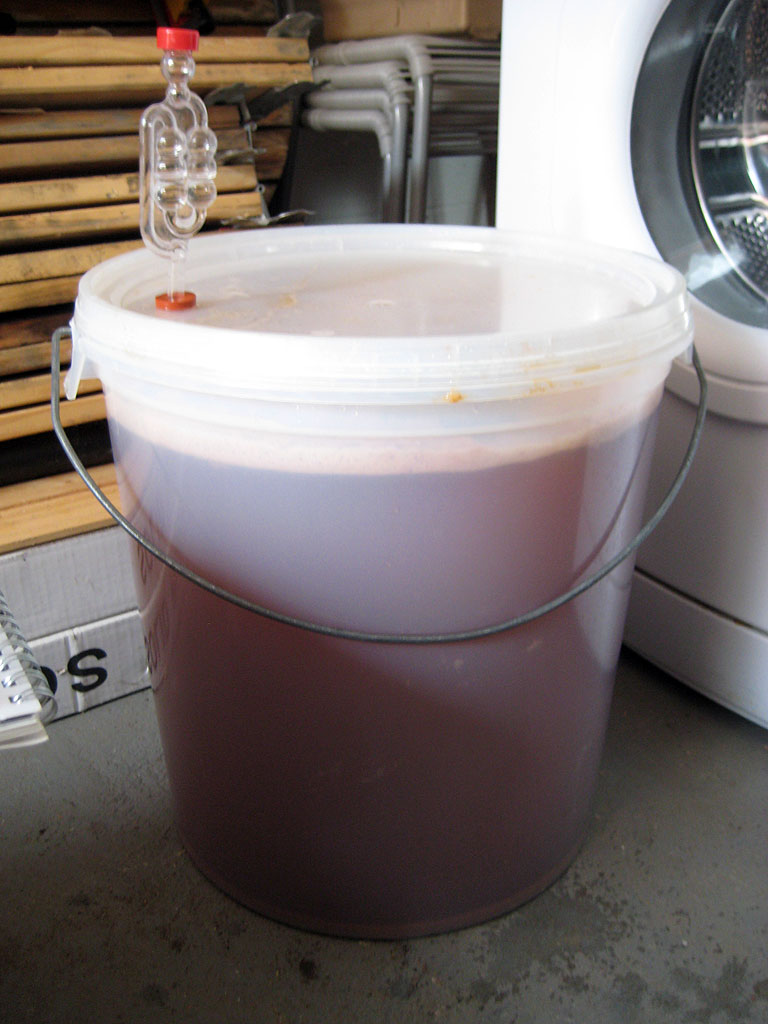
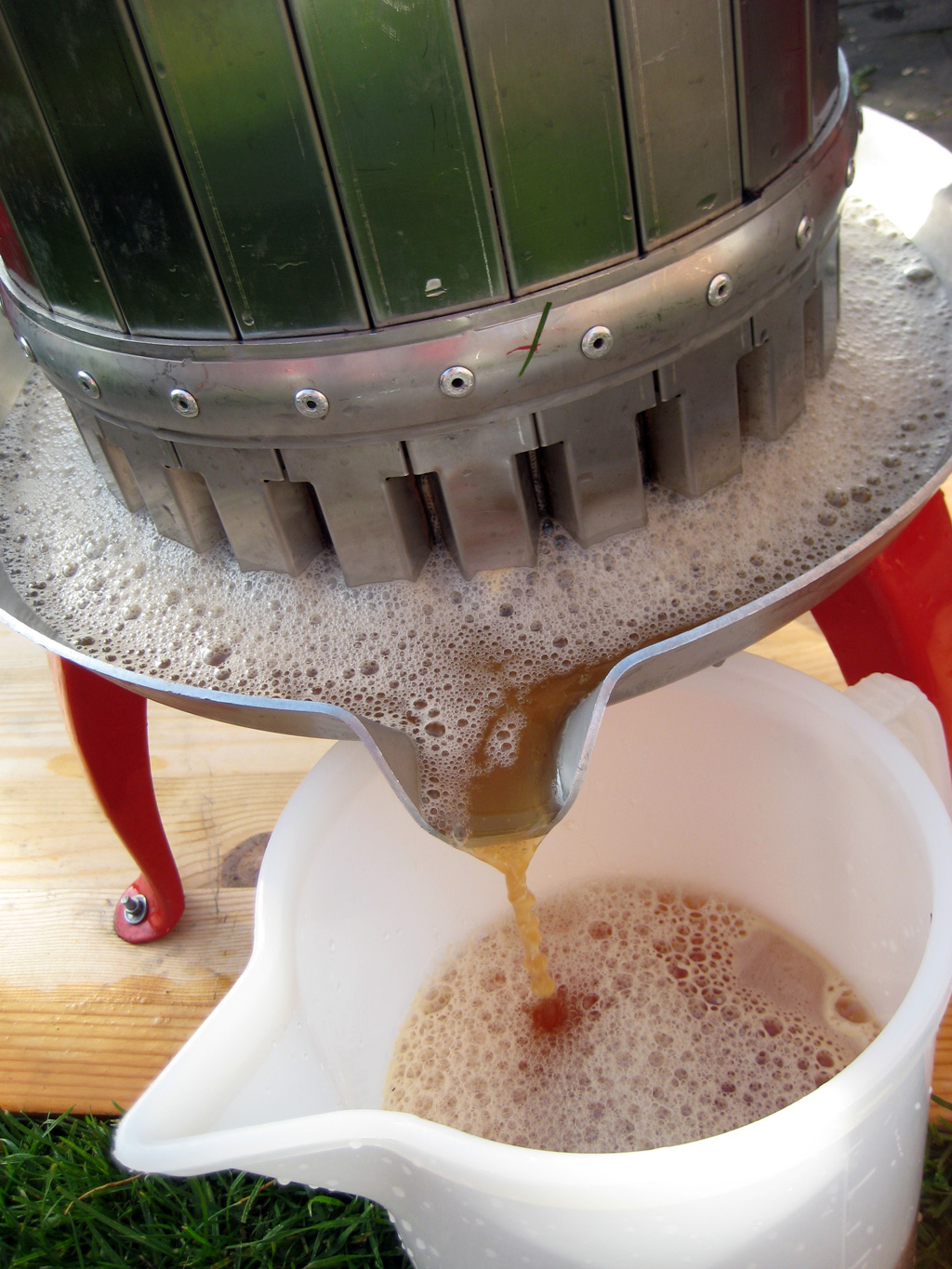
10 litres of juice-to-be

10 litres of juice-to-be

Set up time is the biggest job I feel – cleaning equipment, arranging things in the right place so you can access each stage without going arse over proverbial in the rush to finish the job. The sun was out, indeed it was a glorious day to sit and make apple juice.
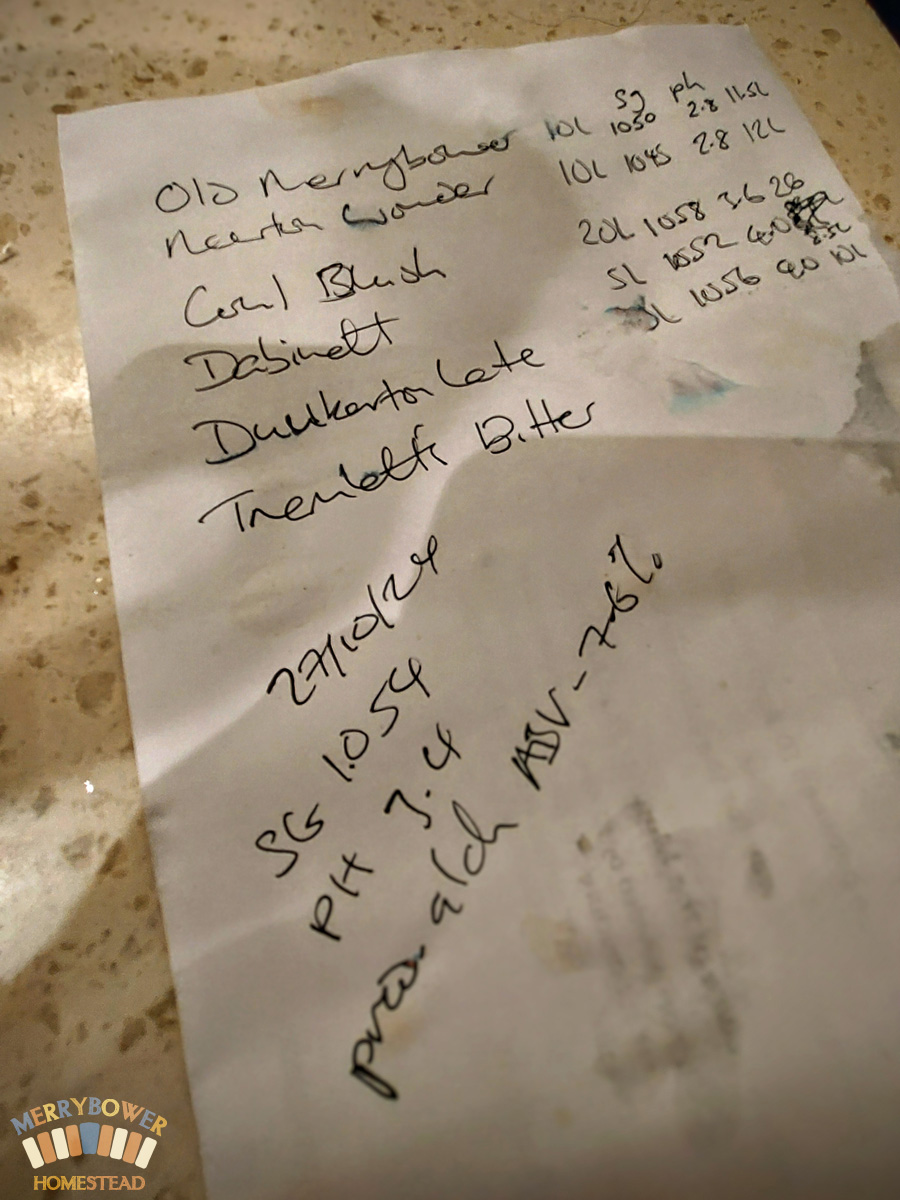
My kind of shopping list

My kind of shopping list

The great thing about having a few years of doing this under the (ever expanding) belt, is that the process becomes less daunting. Outside it’s making sure the washing buckets are arranged in a neat line, the press has a wheel barrow next to it for the pomace, the scratter’s electric supply is far enough away from the liquids! Inside the house sits the notepad for the pH and Specific Gravity readings – useful for this batch, but also useful for ongoing records. I keep a spreadsheet for both readings by apple type, which makes it easier to plan a press in the future, for that ever elusive set of perfect readings.

To help with that process, I don’t press different apple types at the same time – each type is pressed individually. It also helps avoid a situation where one apple type is just unsuitable for pressing; yes, I’m looking at you Yellow Ingestrie. I’ll never forget being covered in small pieces of yellow apple flesh as it literally bursts through the holes in the press, in every direction.

Final Mix

VarietyAttributePercentage MixSpecific GravitypH
Old MerrybowerSharp17%1.0502.8
Newton WonderSharp18%1.0452.8
DabinettBittersweet12%1.0524.0
Dunkerton LateSweet15%1.0564.0
Coul BlushSweet38%1.0583.6

Old Merrybower is a variety we know nothing about, other than the tree we have has been grown from an old (150-200 years old) full standard tree that blew down in a storm about ten years ago at Merrybower Farm next door. As luck would have it, I had just learned to graft fruit trees, so I nipped out to the falled tree, one of the last survivors of the old farm orchard, and took several scions from it. The farm has a replacement tree, and we have one. It’s an acid cooker, but not as sharp as a Bramley (what is?!). Great for adding acid to the mix, for preserving properties.

Newton Wonder is our local apple variety, from Kings Newton, and is another sub-acid cooking apple that is quite edible raw later in the season. I would say it has a more complex flavour profile than the Old Merrybower, but again, acid enough as a preserver.

Dabinett is a classic cider apple – great for pressing, and is termed a ‘bittersweet’. It’s not rocket science to figure out that it’s sweet, but also has that bitter quality that gives cider it’s ‘body’ and depth of flavour. I was hoping to use Tremlett’s Bitter in the mix as well, but it didn’t quite have the body I wanted.

Dunkerton Late was earlier than I expected, but is just pure sugar in apple form. Not even particularly apple-y if I’m honest. It’s the first time I’ve used it – it was planted in the hope that it could provide sugar for all of the later cropping acid apples, as sweet dessert apples, other than russets, seem to be early/mid season croppers.

Coul Blush – I have high hopes for this one. It doesn’t have quite the depth and flavour complexity of, say, Ellison’s Orange, but it definitely got better the longer it stayed on the tree, and is quite sweet, for that all important sugar to alcohol conversion needed to kill unwanted bugs off. It’s a variety that’s used as one of the botanicals in Caorunn gin, so there must be something about its flavour that others have also seen! These were the last from the tree, so I imagine at their peak for cider-making purposes. We’ll soon see!

Juice Analysis

Honestly, the analysis can be taken with a pinch of salt – I had an educated guess at the tannin and malic acid content of Old Merrybower, Coul Blush and Dunkerton Late, as I could find no data on them. As it stands, it looks to be a slightly acidic, less full-bodied cider than the ‘ideal’, but my last full-on tannin cider was too bitter for my taste, so I’m not distraught. And 7.6% is by no means the weakest I’ve made before, so no complaints there!

SugarMalic AcidTannin
Ideal Cider Value15.00%0.40%0.20%
Cider 113.87%0.46%0.09%

Cider No.3 Pressing & Cider No.2 Update

Cider No.3 Pressing

2017 Cider No.3 PressingThe final cider making day of the year, and what a day was forecast! A height of five degrees Celsius, with rain from mid-day to mid-afternoon – lovely! The thermals were extracted from the rear of the wardrobe where they’d lain since last winter, and with four layers on I ventured out, double-socked and ready for anything. A pub brolly, kindly donated by our friend Nev, cast its welcome shadow over the scratter and chopping board, with my little gnome seat central to the whole operation. I felt I was about to perform a Phil Collins’ drum solo, with more apples and less drums. Everything bar the press was within arm’s reach of the command centre gnome seat; baskets of apples, two cleaning tubs filled with water (a double-dip operation to remove large dirt, then finer grime), a second gnome seat to balance the chopping board on, the scratter, a cast-off’s bin for disgarded apple bits cut out, and a barrow for the pomace. Maybe next year I’ll do it wearing a gorilla costume.

I’m not complaining though, whilst I had the luxury of sitting/stooping, Suz and Bunny were down the patch, cleaning out the chooks, whilst Smiler was duck and goose cleaning!

I’d only got a 25 litre fermentation bin to fill this time, so not too bad. Realising that I wouldn’t be able to use all of the apples at my disposal, I started with the main varieties I was interested in using. I should say at this stage that I’m really excited about this cider – it uses our local Newton Wonder apple and a Normandy bittersweet that is finally giving a good crop.

I tend to work on the rough visual amount of apples to figure out the eventual mix, which is a rather ambiguous method as each variety gives a differing amount of juice for its weight and size. Therefore, for the first time, I actually measured the amount of juice going into the mix! I need to be careful as it’s getting a bit too accurate for my liking 🙂 The eventual mix was something like this:

Apple VarietySpecific GravitypHVolume (Litres)% of MixCrates
Newton Wonder1.056~3.210.041%1.2
Medaille d'Or1.066~3.25.522.5%1.0
Forfar1.0623.24.016.5%0.5
Rosemary Russet1.060~3.23.514%0.5
Dabinett1.0544.21.56%0.2

Based on my basic knowledge of the varieties, the sweet,sharp and bitter mix ended up something like:

21% acid
65% sweet
14% bitter

(This is assuming Newton Wonder is subacid – 50/50 acid/sweet, Medaille d’Or is bittersweet – 50/50 bitter/sweet, Forfar is 100% sweet, Rosemary Russet is 100% sweet and Dabinett is bittersweet – 50/50 bitter/sweet).

The final SG reading was 1.060 and the pH was 3.2 – both respectable!

As you can see, we’ve invested in some proper crates! Up until now it has been a mix of the hand cart and donated mushroom boxes. As the quantities are getting larger, we’ve had to step up to euro containers, which are perfect for lugging food items around in, and if you buy used you can get a real bargain! Again, for the record, I’ve also added how full a crate was, so in future I can work out the volume of liquid to expect from a given number of apples – this was a good run for working these varieties out as there was very little spoilage and therefore wastage.

I’ll add a page in the future with all this data in, and also save it to the main fruit spreadsheet, which desperately needs updating with the one on my computer!

Cider No.2 Update

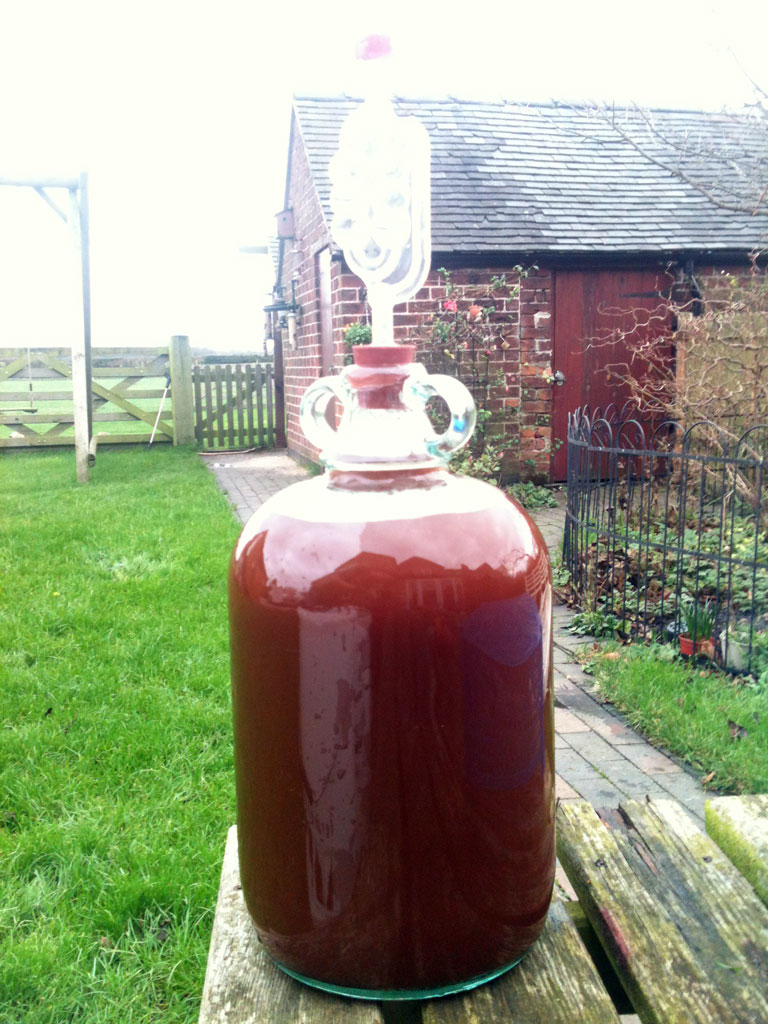
The juice sat for around two weeks in the unheated garage, and finally started to ferment, nice and steadily. Today the specific gravity is 1.020, and it’s beginning to clear nicely. I’m going to rack it as soon as it gets to 1.015, and then bottle it at 1.005, for a natural carbonation as it matures in the bottle. By next summer it should be done!

Cider Thoughts 2017 & Cider No.1

As the orchard matures, new trees become available and the choice can be overwhelming when it comes to choosing which to press together. Liking to keep things simple, as life can be complicated enough as is, I prefer the idea of pressing apples in batches – those that have ripened and been picked at the same time. This is how we’ve pretty much done it since day 1, and at our scale with one tree of each variety, it makes sense from a logistics point of view; no hassle with multiple single varieties all bubbling away only to be blended down the line when they’re all ready.

So every year I sit down, assess which trees are currently ready for picking and pressing, which category they fall into with respects cider making – sweets (for the sugar content), sharps (for the acid content) and bitters (for the tannin content), and how much we then need to pick from each. As is usual in the early season, we have plenty of sweet dessert apples, and the early cookers, like Queen and Peasgood’s Nonsuch, tend to be subacid, so not particularly acid. The term ‘subacid’ seems to be an old left-over description for the qualities of an apple variety that is neither particularly sweet or particularly tart – a dual-purpose for want of a better word. The Peasgood’s Nonsuch is classed as a cooking apple, but is not a bad eater in my opinion, although you’d be hard pushed to find a lunch box to pack it in to as they can larger than a baby’s head!

We have only one apple tree that falls into the “bitter” category that is ready early, and that’s the cider apple Tremlett’s Bitter – a Bittersweet apple (having both sweet and bitter qualities). However, this year it failed to fruit due to a late frost killing off the blossom, so it looks as though our Cider No.1 will be more along the lines of the South-East England method, using sharps and sweets (cookers and eaters) in a typical 2:1 ratio. It will, in theory, turn out lighter, crisper but with less body than a cider with more tannins, but that’s also something we’ve ended up with over the years from Cider No.1. It does lead me to think we’d be wise planting some other early bitter varieties as a safety measure. More on that later, as we have a few gaps in the orchard to fill, and I’m sure some serious pondering over one or two of last year’s ciders is in order!

Today we’ve picked:

  • 5% Slack ma Girdle (sweet cider)
  • 5% Elton Beauty (sweet dessert)
  • 10% Yellow Ingestrie (sweet dessert)
  • 35% Warner’s King (sharp culinary)
  • 45% Ellison’s Orange (sweet dessert)
Slack ma Girdle

We’ve included this variety purely for the sweetness factor. If we had other earlier cider varieties to complement it, I’d rather it went in there. As it was, it was ready and would otherwise be wasted!

Elton Beauty

Again, another one at the end of its shelf-life on the tree, it’s one of my personal favourite eating apples we have, along with the Ellison’s Orange below. It would have been a shame to lose the sweetness it brings to the cider.

Yellow Ingestrie

A tiny apple that people seem to find too unusual to eat fresh, though they’re actually missing out on something wonderful!

Yellow Ingestrie

Yellow Ingestrie

Once ripened properly, it turns a lovely warm buttery yellow. The shock in eating is the assumption it will be a bit anaemic in flavour and soft – like an over-ripe Golden Delicious. Nothing could be further from the truth – the flesh is fine, not gritty, almost buttery smooth, and it’s firm and sweet. They are the perfect apple for a young child’s lunch box to be honest! However, we had a good crop, so in they go to Cider No.1!

Warner's King

Warner’s King

Warner’s King

Our earliest culinary apple, over half have fallen off the tree – and these things can be huge! It didn’t look like many and I assumed I might have to pad them out with another cooking apple, but as it was they easily filled a third of the truck, leading me to look for another sweet apple to help balance out the ratios!

Ellison's Orange

Ellison’s Orange & Marsh Daisies

Ellison’s Orange

These have been a favourite at Melbourne Deli, our local customer whose customers appreciate the unusual and scarce varieties we grow here. However, they are at their best right now, and we have the Allington Pippin ripening right next to them which is also a great eating apple, so we’ve decided to pick the rest and add them to the cider mix. I’m hoping, as they’re an offspring of Cox’s Orange Pippin, that they’ll bring some of their complex flavours to the cider, although they are juicier than the Cox, in my opinion, so maybe that might come out a bit diluted. We’ll soon see!

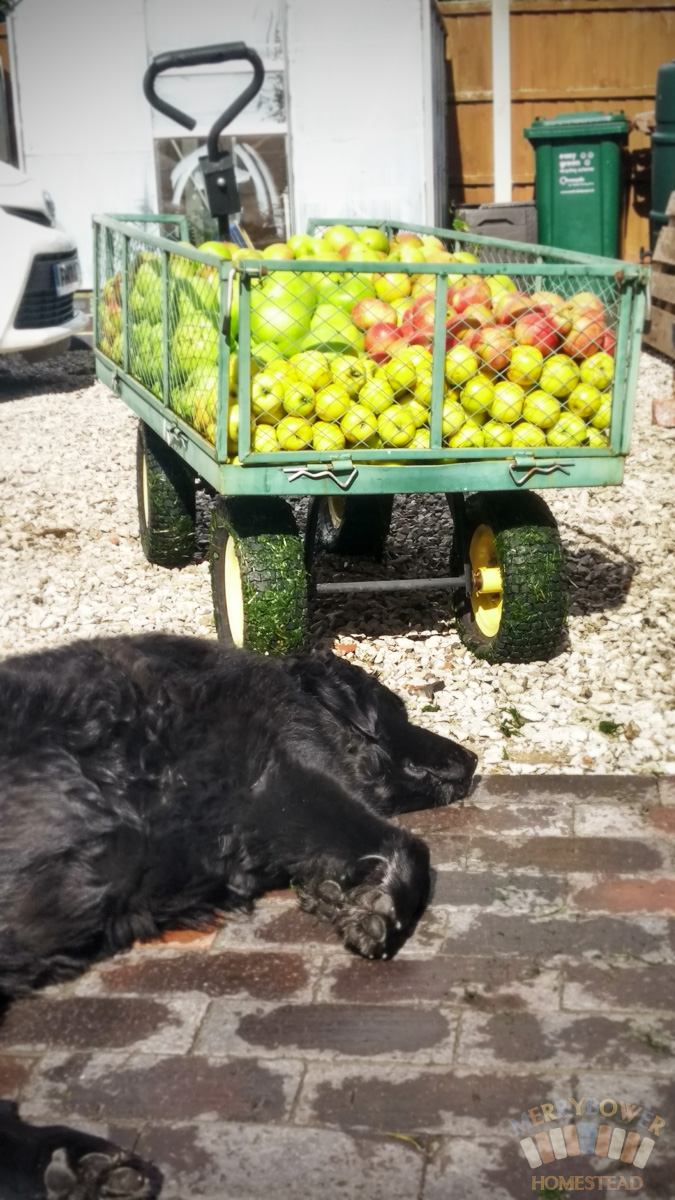
A Full Cart

A Full Cart!

Penny the Guard Dog

No one touches Penny’s apples!

We’re leaving them outside to sweat for a couple of weeks before pressing. The press is booked for this coming weekend for plain non-alcoholic juicing, and then the weekend after for cider-making – then everyone’s happy! Even Penny, who might bag the odd apple to chew on.

2017_Cider_Collection

Ciders No.3 & No.4 – “Half Cock” & “Cock On”

It’s a bit of a random post, as it was so hectic here grouting tiles and working on the kitchen extension before Christmas hit us, that I totally forgot to write up the last two ciders, or even take any photographs of the pressing day!

In a nutshell, our third cider was meant to be the trusty “Sydney Camm’s Marvel Machine” – a mix of Dabinett, Rosemary Russet and Newton Wonder. When I came to pick the apples from the three trees, the Dabinett was bare! Scratching my head, I can only surmise that in all of the chaos life had thrown at us, that I had seen some on the floor and decided to plop them all into the Tally Ho! cider! Shock! As it was, the resulting third cider was a mix of Rosemary Russet, Newton Wonder, and as many dessert apples as I could scrump from our neighbours (again).

Again, I thought this was the cider I was going to attempt to carbonate naturally, measuring the sugar levels until we’d reached 1.005 and then bottling it, allowing the resulting CO2 given off by the yeast to stay within the cider. But, business again meant the 30 litre tub, sat behind me as I worked, fermented to dryness. No fear – I bottled half of it as a dry still cider – calling it “Half Cock” in tribute to the fact it wasn’t quite what I’d wanted to do. The other half I innoculated with 5g of sugar melted into water as a solution as I bottled it. After a two weeks in the kitchen where the remaining yeast could get going on the sugar, I moved it to the cooler garage. This one is a corker! It’s got a lovely ‘mousse’ as they call it – a fizz with gentler, smaller bubbles than you’d get in can of Coke or Pepsi, and cold it’s really refreshing! I just now wish I’d made all of it this way!

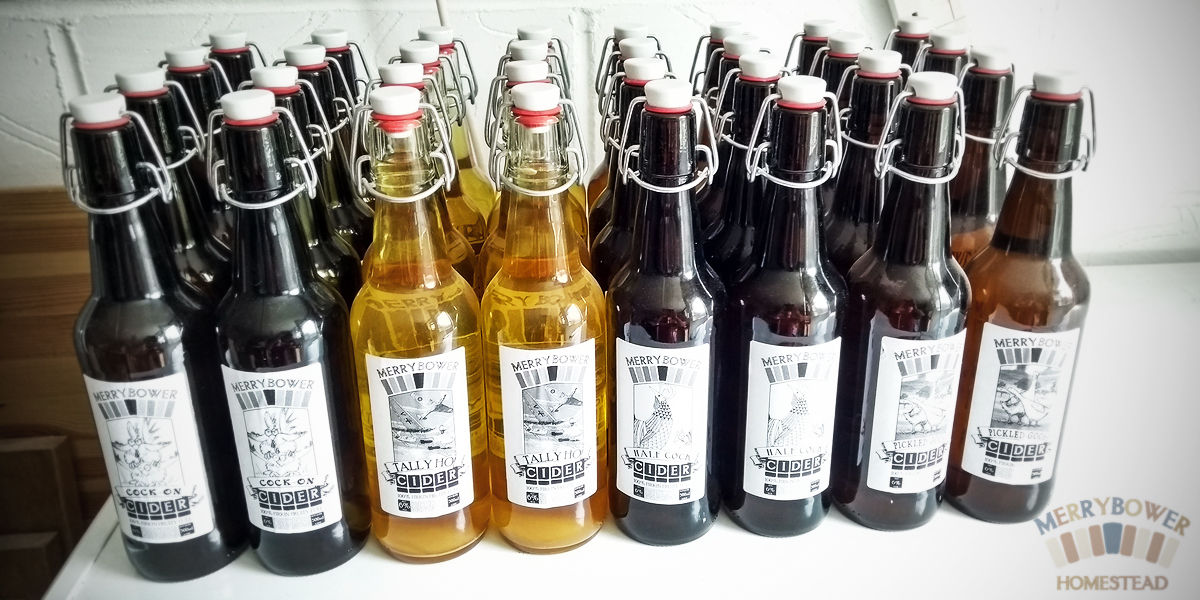
Cock On, Tally Ho!, Half Cock and Pickled GooseThis is the final line up of this year’s ciders – next year we’ll hopefully not have Half Cock or Cock On again, but the Sydney Camm’s will hopefully be fizzy at last!

Cider No.1 – “Pickled Goose”

We have a new cider – Pickled Goose! Cider No.1, as it has been fondly known since pressing it in early October, is a mix of Tremlett’s Bitter, Lord Derby, Ellison’s Orange and Forfar. It fermented reasonably quickly, over the course of four weeks, and is now bottled – ready to drink! I have to admit, I haven’t drunk it in anger yet, and feel the need to drink a bottle of it alongside cider No.2 (Tally Ho) is in order, to compare flavours. Again, as every other time, I’ve missed the chance to bottle it with some reserve sugar still unfermented, so it’s a flat dry cider. It didn’t help that I was away when it finished!

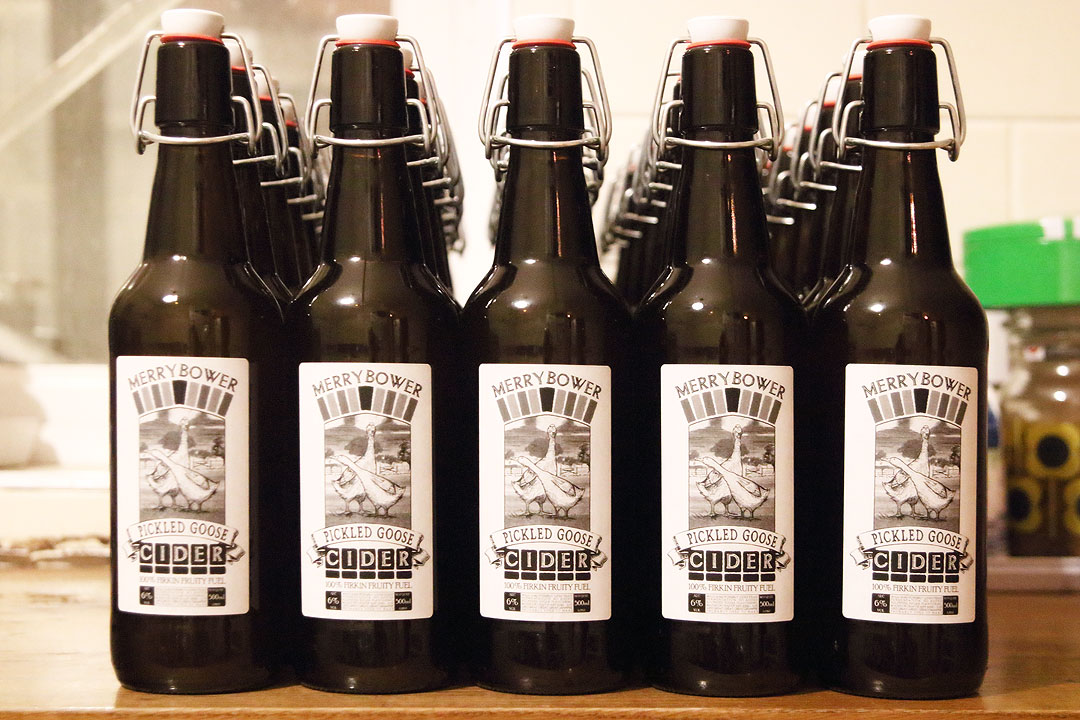
2016 cider 1e Pickled Goose

Pickled Goose cider

The name? Well, we have animals here as you know, but we’ve never used them on a label to date. These two chaps are Barty and Harold, our resident Pilgrim males – who are always acting up, deciding which bit of any unsuspecting human they should sample first. In fairness, Harold has a bit more about him and realises that the humans bring water and corn, so he tends to nip Barty on the back when Barty attempts an attack. During a chat with a friend from abroad, he misheard me and thought I’d mentioned ‘Pickled Goose’, and wrongly assumed it was some sort of thing the English did! Knowing how our two chaps behave, it seemed an appropriate name for a new cider, and there we have it! And before anyone mentions it, yes I know they’re ganders, but it’s just a matter of semantics 🙂

Cider No.2 – “Tally Ho”

Back on the 26th October we pressed our second cider, under the name “Tally Ho”, as this is the year’s random cider (you dive in and never sure whether you’ll come out the other side…).

For the record, we used Harvey, Sanspareil, Ashmeads Kernel, Barnack Orange, Ribston Pippin and Wyken Pippin. We also threw in some randoms donated by Mick at No.1, and a few off the good old Bountiful tree next to the house. Also, much to my chagrin once I’d realised what I’d done, we added a tree full of Dabinett. These were meant to be used in the third cider, mixed with our Newton Wonders and Egremont Russets, but alas this is not to be. I fear it was a bit too early for the Dabinetts, but hey ho, Cider No.2 worked.

2016 Tally Ho Cider

Tally Ho cider

I say worked, the specific gravity began at 1.046, and we had no bubbles whatsoever. So I moved it into the house, into a room which stays around the 16-17 celcius mark, and after a week still nothing. So I took a litre of cider No.1, which was happily bubbling away, and this seemed to get things going, albeit slower than a drunk slug. After a couple of days of slow bubbling, it all stopped again. I left it, thinking it might kick in after a week or so, and after two weeks finally tested the SG to see how bad things were. To my astonishment, it sat at 1.000, meaning the darned thing had fermented to dry without me noticing! I can only assume there’s a leak in the fermentation bin somewhere, but it’s bottled and ready. Again, it’s another 6% cider, and again, I missed the opportunity to bottle it before it had finished, meaning no chance of bubbles in the bottle. Ah well, next year!

Cider No.1 of 2016

2016 cider 1d

With the Ellisons Orange in the truck, it was time to pick the Tremlett’s Bitter

2016 cider 1c

The Forfar are in the foreground, with the Lord Derby in the far left of the truck

Around a week ago we picked the apples for the first cider, which would allow them to sweat for a week outside. This would give the starch time to convert to sugar prior to pressing, and a quick test with iodine tincture proved that they were indeed ready after one week. Typically I would wait for the apples to begin to drop, and I do remember a seasoned cider maker stating that he tended to use one third of the apples from the ground to two thirds from the tree. I think this was partially because he knew they were ripe in general, and also because those on the ground were busy picking up the necessary wild yeasts that would later help with fermentation. I’m not sure of the validity, but I do it anyway, in case!


2016 cider 1b

The 2016 Milling Station!

Today was the day we made our first cider – No.1 of 2016. The specific gravity was 1.046 at the start, 60 pints scratted and pressed into one large plastic fermentation bin. I loan the scratter from our local transtion group, and this time it came with no supports. Luckliy, two spare pallets hanging by, a few nails and a random piece of wood leant themselves to a scratter stand which also aided the back due to its bespoke height! Eat your heart out Heath Robinson!

2016 cider 1a

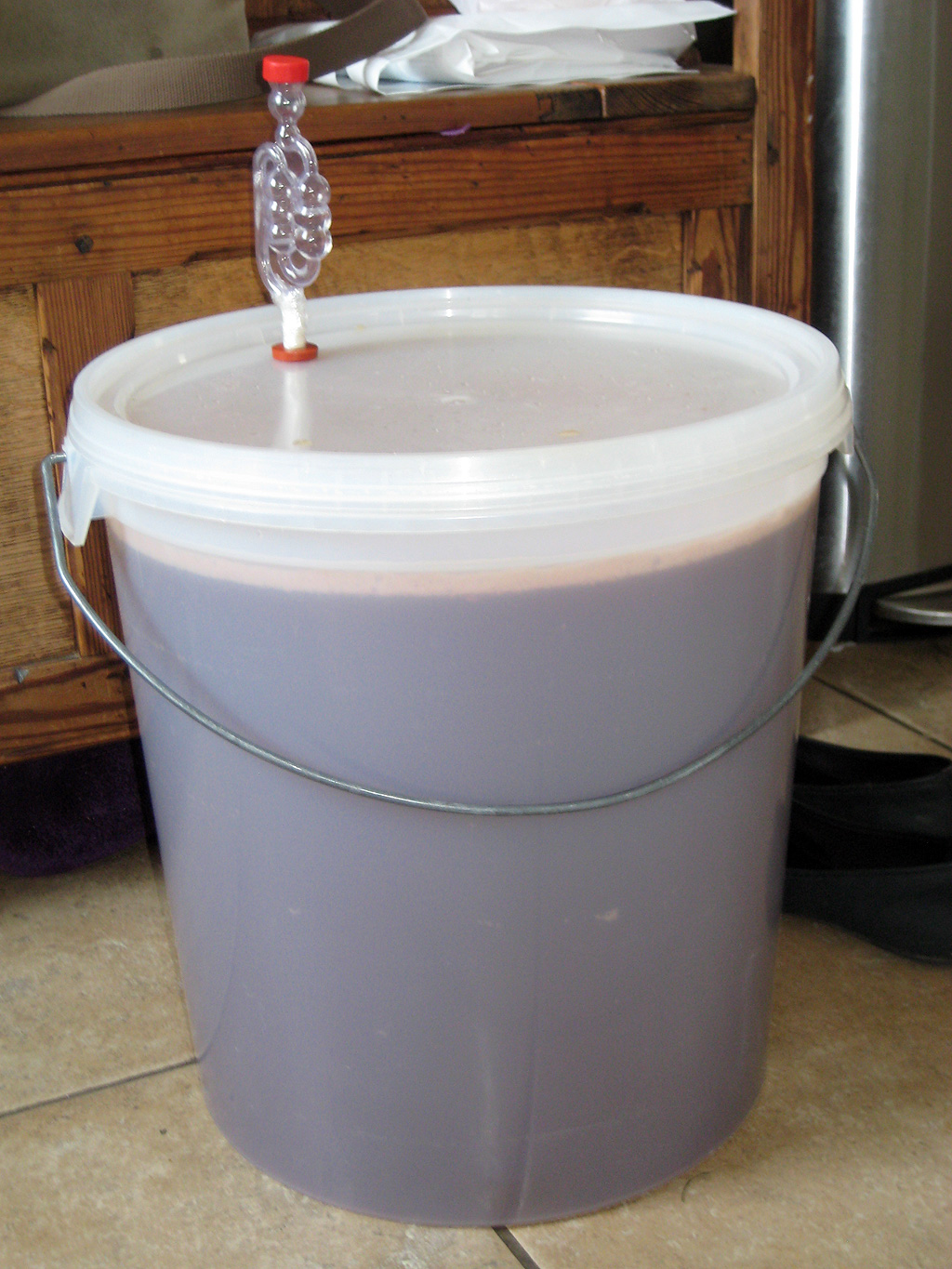
60 pints of fruit juice waiting to metamorphosize.

The cider was, as almost predicted, a mix of 33% Tremlett’s Bitter (cider), 33% Lord Derby (culinary), 20% Ellison’s Orange (Dessert) and 13% Forfar (Dessert/Culinary). Of course, to mess up the percentages there wasn’t quite enough to fill the fermentation bin, so I ended up adding 5 litres (mixing units now too I see!) of Bountiful, another culinary/dessert. The heaviness towards the culinary/desserts might help explain the relatively low SG, though it’s still within the bondaries of acceptable, for storage. It might just come out tart – we’ll soon see (hopefully)!


Cider No.2 – Sydney Camm’s Marvel Machine

2016 cider sydney camm's marvel machineSydney Camm’s Marvel Machine is a popular phrase amongst a group of friends sharing a passion for flighty things (not the poultry type) and has always been a name chosen to adourn a cider. This cider, our second ‘mix’, is a little bit thought out, in that I know two of the varieties for sure! It’s approximately one third Dabinet cider apples, one third Rosemary Russets and one third a random cooker scrumped from Farmer John next door. You can see what it used to look like back in December, here.

As it used late varieties, in started to ferment, and then went dormant over winter, which is what I’ve been looking for. Come April it sprang back into life again and continued with a slow ferment. Still going this week with a bubble every twelve minutes or so from the airlock, I decided to measure the SG, which came out at around 1.000 – a bit above total dry. Bottling now is safe, but I don’t have the experience to know if there’s enough SG left to create a natural carbonation in the bottle – we’ll soon see, unless we drink it all before that happens! It did taste fuller bodied though, and a touch sweeter, but still very much a dry cider. This is the second time a Dabinet-based cider has overwintered, so this coming season I’ll make another version of Sydney Camm’s Marvel Machine, but replace the unknown cooker with a known variety, and bottle it with a slightly higher SG to ensure in-bottle carbonation.

Save

Cider Making – The Second Batch

2015 Second Cider MakingMore cider making! Today I made the second batch of cider – just enough for one gallon demijohn this time, and three pints of apple juice left over for drinking neat. The apples were a mix of Dabinet (cider), Rosemary Russet and a random cooker begged from Farmer John next door. The specific gravity came out at 1052, so a potential alchohol level of around 6.3%. As I sadly failed last time to intercept the fermentation in time to bottle condition the cider before the cider turned dry, I’m hoping the weather turns cold enough for me to have a bash this time. However, with doors still open as it’s too warm inside, and trundling around in a t-shirt as it’s around 14 Celsius outside, I fear this batch will also ferment too quickly. Ah well – it’ll be interesting to taste the difference between two ciders this year!
Year 2 – Cider Making

2015 Cider Making 1What a gorgeous morning to start cider making (hard cider to our friends in the US)! I’d booked the scratter and press from Melbourne Area Transition a few weeks ago, giving us time to pick the apples that were ready to crush, and leave them outside for three weeks to ‘sweat’ – if the weather had been wetter then we’d been advised to move them under cover as heat and wet can spoil them.

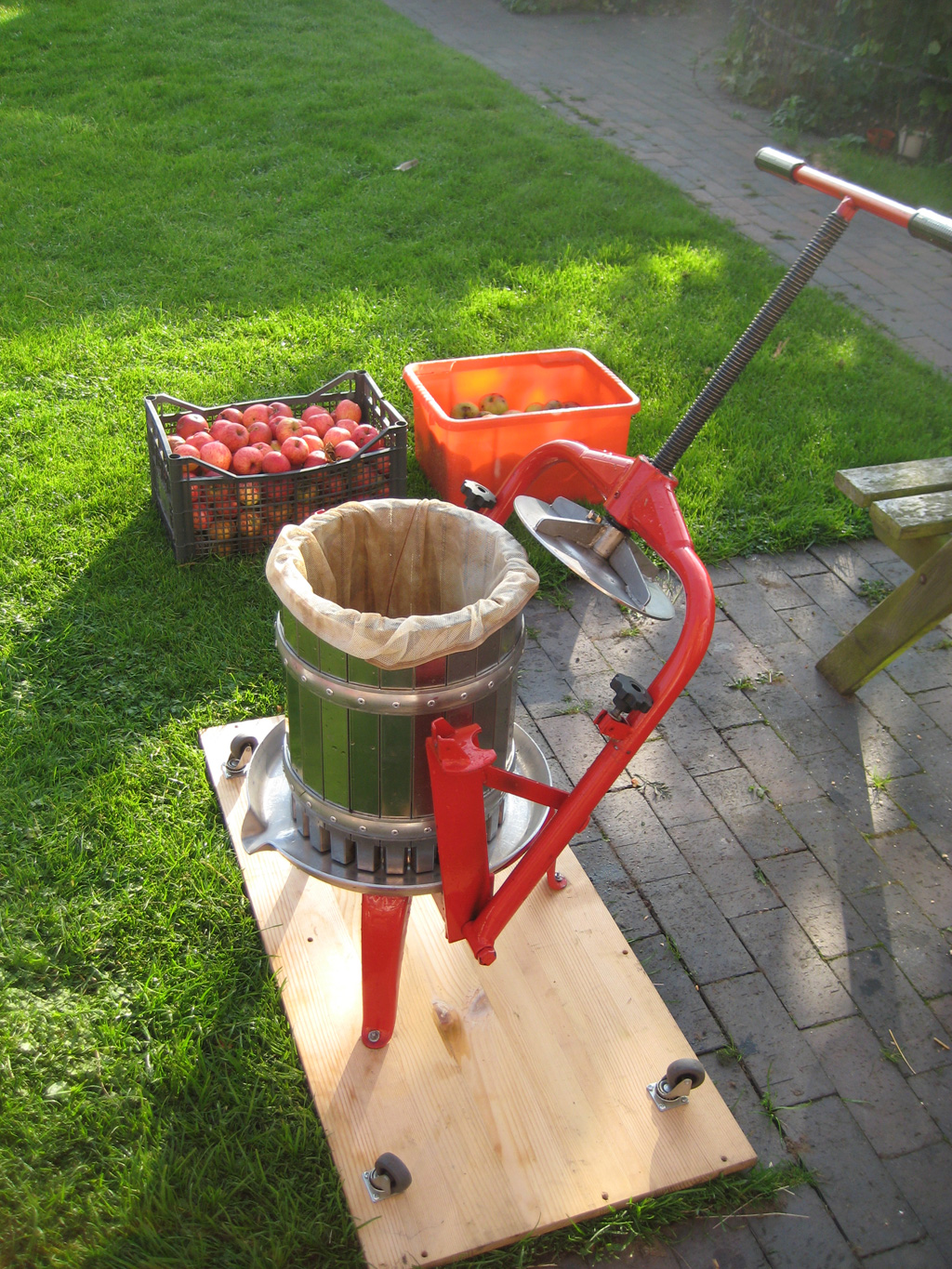
2015 Cider Making 2The press was a 20 litre cross beam press – a bit larger than our 5 litre spindle press, which really isn’t useful for any quantity of cider, but probably more suited for crushing soft fruits for juice.

2015 Cider Making 4The scratter could take around six whole average-sized apples in one go, or you could fill the hopper with cut apples. I chose the first method as it was easier with only one person, but it was a doddle!

2015 Cider Making 3The apples we used were roughly 60% dessert, 30% culinary and 10% cider. I had grand ideas of a ‘mix’ of certain types, but when it came down to it I took what we could get – around a third came from our lovely neighbours at number 1, the rest we scrounged from our trees – there were definitely Warner’s King, Elton Beauty and Catshead – the rest I really can’t remember, or I don’t know – hopefully next year I’ll be more organised!

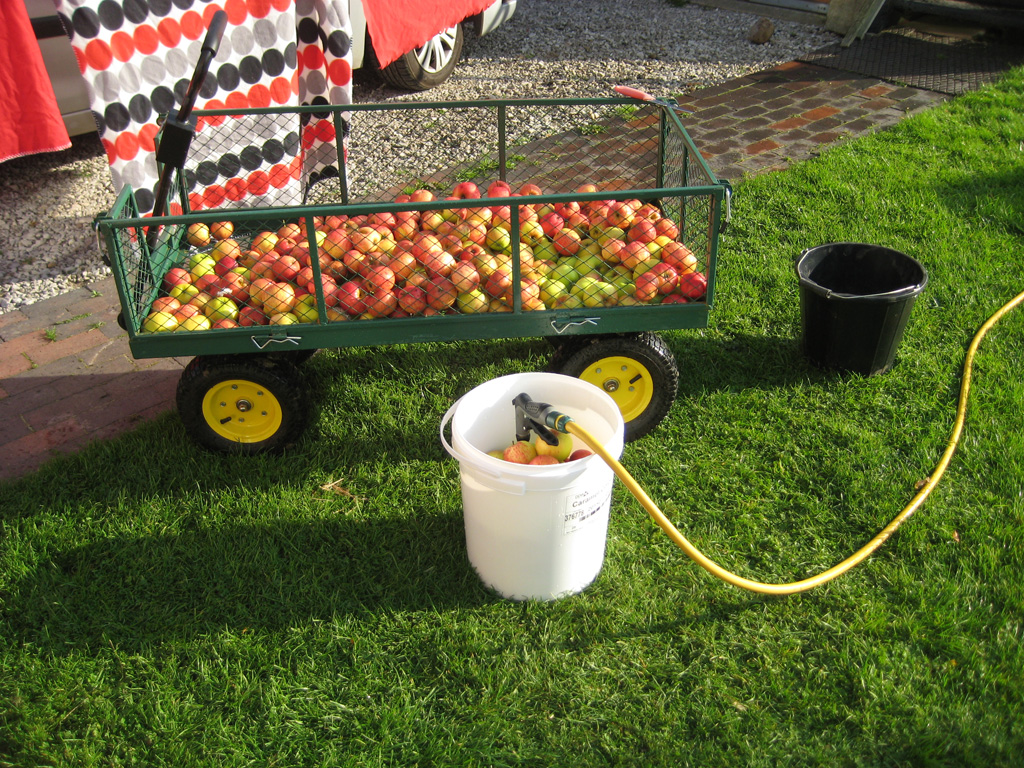
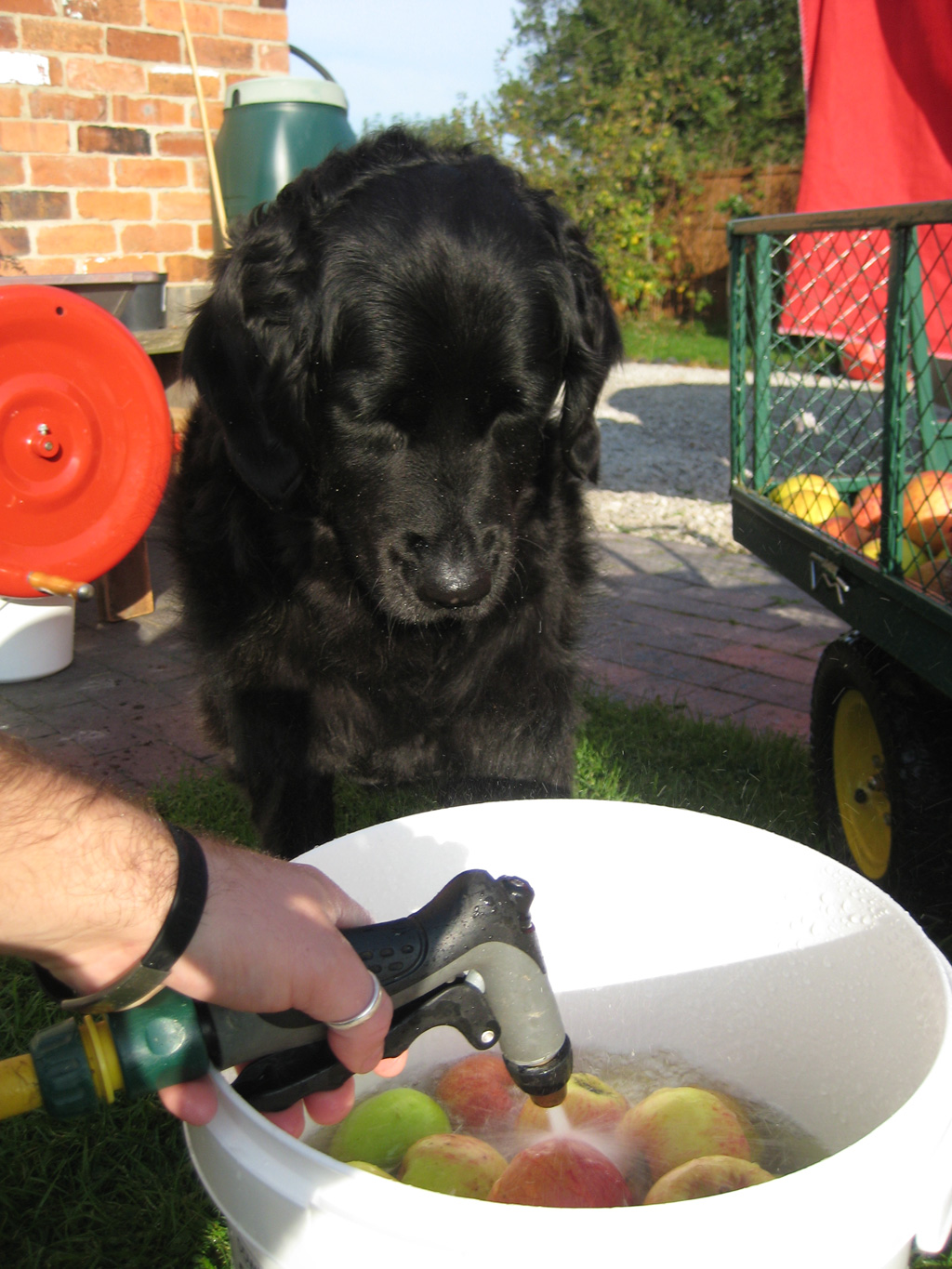
2015 Cider Making 5The cider making method was simple – apples began in the green cart, a half bucket loaded into the white bucket, hosed down, washed around and inspected by Penny, who would have jumped in the bucket if there had been the slightest chance she’d fit! Then six at a time were dropped in to the scratter and munched into tiny pieces. It took about one full washing bucket to fill the smaller 2 gallon bucket which sat under the scratter. Two of the 2 gallon buckets of pomace filled the 20 litre press (don’t you love mixing imperial with metric?), so basically 2015 Cider Making 6two stints on the scratter for every stint on the press, and the press gave between 4 and 5 litres per pressing (that’s the white pouring jug under the press). The pomace left over after pressing didn’t feel as dry as that from the spindle press last year, but the pieces of apple seemed a bit chunkier than last year, so maybe that had something to do with it? Or maybe because we’d let the apples sweat some of their juice out – who knows!

Anyway – it took me about 6 presses to fill my 7 gallon fermentation bin, and about three hours in total, maybe a bit more. Assuming it works, that’s around 55 pints (assume one lost to keeving later into another vessel) – not bad for three hours’ (enjoyable) work! Last year was heart-breakingly slow, with our tiny press, and I expected this year to feel as bad – in terms of the effort-to-produce ratio.

2015 Cider Making 7But this cider making experience was a whole different ball game! To see the juice pouring from the press was a beautiful sight – and makes me realise that we need at least a 40 litre press. We really do need to decide in which direction to take this, once we have some experience under our belt? Do we stay as hobbiests, making our own product for friends and family to enjoy, or do we expand the idea to create a mini business that can self-fund? We’ll have plenty of apples to play with, there’s no doubting that! Plenty of time to worry about that, and for now it’s great that people like Melbourne Transition rent out kit that can suit a serious hobbiest.

A quick reading of the Specific Gravity showed 1.046, at a room temperature of around 19 degrees, which is fine. Again, as last year, I’ve decided not to sulphite, to rid the juice of wild yeast. That would mean adding a known yeast back into the cider, but I quite like the idea of seeing if natural yeast, present in the air and on the apple and pressing equipment, can do the job for us. Health-wise – sulphites can cause problems with people suffering from asthma, or people with allergies to sulphites themselves.

2015 Cider Making 8As it was, Jay and Smiler came back from school just as I’d finished – impeccable timing! Seeing the press, the dived right in and pressed out another 4 litres of apple juice from the Forfar tree – a light and slightly acidic juice, but then we may have been a bit early picking them. It only seems fair to press something they can also enjoy.

Despite that being the end of our first cider making day, we’re not done yet – we have some later maturing varieties on the trees still, so hopefully we’ll do another pressing come late November, early December 🙂